
|
|
 (42) |
|
||||||||
| Napoléon
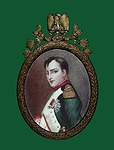
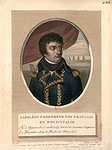
I Emperor of the French (1769–1821) Other names: Napoléon Bonaparte, Napoleon Buonaparte, the Corsican, Little Corporal Biographical Emperor of the French 1804–14 abd., 1815 abd. King of Italy 1804–14, abd. Prince of Elba 1814 Protector of the Confederation of the Rhine 1806–13 Mediator of the Swiss Confederation 1803–15 Consul 1802–1804 First Consul 1799–1804 General 1794 Napoleon, the second son of Charles Bonaparte, assessor to the royal tribunal of Corsica, began his education at the Military School of Brienne in 1779, transferring to Paris in 1784. Commissioned second-lieutenant of artillery in 1785, he served during the Revolution against the Marsellais and commanded artillery at Toulon in 1793, earning promotion to general of brigade. In 1795, second in command under Barras, he helped repel the Paris Sections’ attack. In 1796, appointed commander of the Army of Italy, he married Josephine and soon after launched a campaign demonstrating his military brilliance. Leading 36,000 troops against Piedmontese and Austrian forces, he won decisive victories at Mondovi, Lodi, and elsewhere, forcing Sardinia to sue for peace. He then advanced through northern Italy, capturing Verona and Legnago, and after hard-fought battles at Arcola, Rivoli, and Mantua, secured French dominance in the region. Advancing on Vienna in 1797, his successes compelled Austria to sue for peace, leading to the Treaty of Campo-Formio, by which France gained Belgium, Lombardy, and other territories. Although appointed to the Army of England, Napoleon redirected efforts to an expedition in Egypt in 1798, capturing Malta and Alexandria before his fleet was destroyed by Nelson at the Nile. He attempted to spread revolution into Syria but failed to capture Acre, eventually returning to France in 1799 amid growing political instability. Joining forces with Sieyès, he orchestrated the Coup of 18 Brumaire, establishing the Consulate with himself as First Consul. He sought peace with England and Austria but resumed hostilities in Italy, winning the Battle of Marengo in 1800, which consolidated French control. Peace followed with treaties of Lunéville, Amiens, and concordat with Rome. As First Consul for life, he prepared for war with England, becoming Emperor in 1804. In 1805, he defeated Austria and Russia at Ulm and Austerlitz, ending the Holy Roman Empire and creating the Confederation of the Rhine. His campaigns against Prussia in 1806-07 culminated in victories at Jena and Friedland and the Treaty of Tilsit, which left Napoleon as the dominant power in Europe. He sought to isolate England through the Continental System, yet resistance grew, particularly in Spain and Portugal where British forces under Wellesley fought against French occupation, inaugurating the Peninsular War. In 1809, he again defeated Austria, securing territorial gains by the Treaty of Schönbrunn. Seeking an heir, he divorced Josephine and married Archduchess Maria Louisa in 1810; their son was born in 1811. His invasion of Russia in 1812 ended disastrously with the burning of Moscow and a catastrophic retreat through the winter, decimating his Grande Armée. The coalition of European powers then pressed the war in Germany; despite initial victories in 1813, including at Dresden, Napoleon was defeated at Leipzig and forced to retreat. In 1814, with allies invading France, he abdicated and was exiled to Elba, while the Bourbon monarchy was restored. The return of Louis XVIII was unpopular, stirring unrest in the army and society, and Napoleon escaped Elba in 1815, regaining power for a brief period. His final campaign ended with his decisive defeat at Waterloo, after which he abdicated and surrendered to the British. He was exiled to St Helena, where he died of cancer of the stomach. His remains were returned to Paris and interred in the Invalides. Place of birth: Ajaccio Place of first marriage: Paris Place of second marriage: Paris Place of death: St Helena Place of burial: St Helena; transferred to Hôtel des Invalides, Paris, in 1840 Son of Charles Marie Bonaparte and Marie Laetitia Ramolino. He was married firstly to Josephine de Tascher de La Pagerie in 1796 (divorced 1809), and had no issue; secondly to Marie Louise, Archduchess of Austria (Habsburg) in 1810, and had issue. He also had illegitimate issue. |
||||||||||
| |
||||||||||



 |
||||||||||
| |
||||||||||
|


