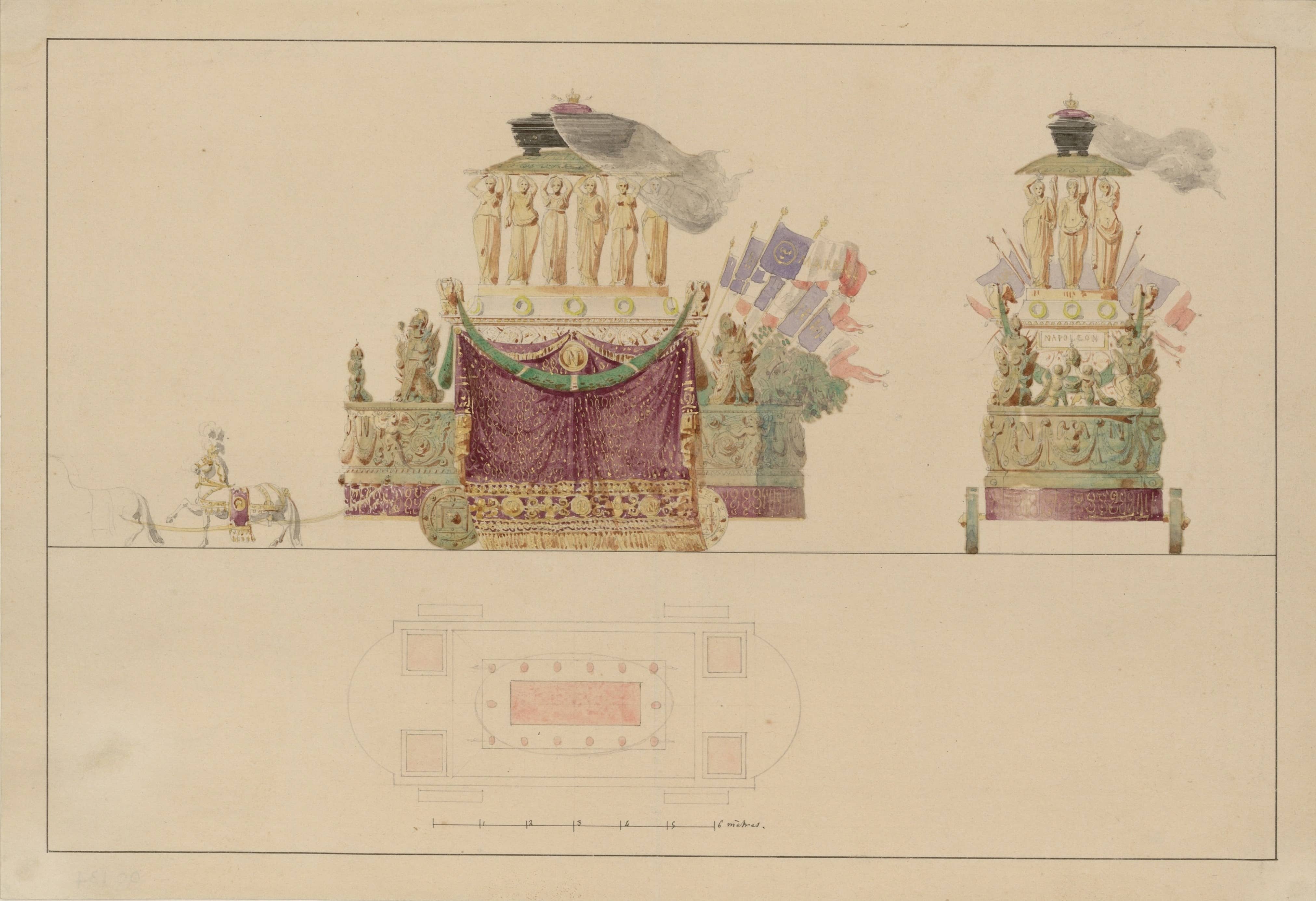
In 1840, a project was
undertaken for the design of the chariot intended to carry the ashes
of Napoleon I, who had died in captivity on the island of Saint
Helena on 5 May 1821. This highly symbolic event, known as the
Retour des Cendres, was orchestrated under the direction of Adolphe
Thiers and King Louis-Philippe, reflecting a broader effort to
reconcile the legacy of the Empire with the July Monarchy. The
translation of Napoleon’s mortal remains to their final resting
place at Les Invalides was not only a moment of national pageantry
but also a carefully planned architectural and ceremonial
undertaking. Henri Labrouste, noted for his innovative approach to
public architecture, was entrusted with overseeing the ceremonial
aspects of the transfer, working in collaboration with Louis
Visconti, who would later design the emperor’s tomb. His watercolour
depicts a chariot designed in a neoclassical style, featuring purple
drapery, allegorical statuary, laurel wreaths, and other classical
elements. At its centre stands a sculptural catafalque, surrounded
by symbolic figures, military standards, and French flags. A team of
horses and uniformed attendants emphasises its ceremonial function.