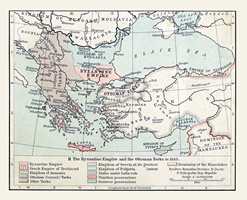
The
Byzantine Empire, emerging from the Eastern Roman Empire after
its division by Emperor Diocletian in the 4th century AD,
became a dominant force in the Mediterranean and Near East.
Its capital, Constantinople (modern-day Istanbul), strategically
located on the Bosphorus, grew into a major hub for trade,
culture, and politics, serving as the empire’s heart
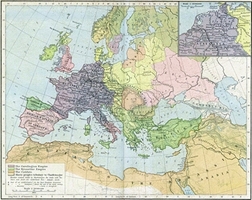
for over a millennium. The empire reached its greatest extent
during the reign of Emperor Justinian I in the 6th century,
when it reclaimed much of the Western Roman territories, including
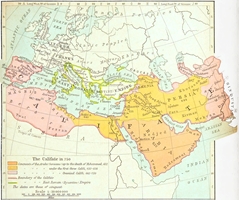
North Africa, Italy, and parts of Spain. However, the empire
was continually challenged by external invasions, notably
from the Persians, Arabs, and later the Seljuk Turks, which
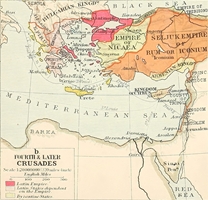
strained its military and economic resources. The Fourth Crusade
in 1204 further weakened the empire when Latin Christian forces
sacked Constantinople, leading to a period of fragmentation
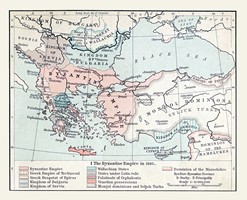
and decline. Despite brief periods of resurgence, the empire’s
power waned over the centuries, with the Ottoman Turks steadily
encroaching on its territory. In 1453, Constantinople fell
to the Ottomans, marking the end of the Byzantine Empire and
the beginning of the Ottoman era, which profoundly transformed
the region. |
Location:
Southeastern Europe, Anatolia, the Levant, Egypt, parts of
North Africa, the Balkans, Greece, Crete, Cyprus, and various
islands in the Aegean and Mediterranean Seas |