Venus
Biographical
Goddess of love,
fertility and gardens
Venus was the Roman goddess of love, especially of sensual love. Before
she became identified with the Greek Aphrodite,
she was a minor deity in Roman religion,
connected to vegetation.
The ancients themselves noted that her name does not appear in any
records from the period of the Roman kings. This is also shown by
the fact that no festival was originally held in her honour. The Vinalia,
celebrated on 23 April and 19 August, were entirely different festivals,
and any connection to Venus arose from a misunderstanding of the name.
This led courtesans to treat 23 April as their own holiday, worshipping
the goddess at a temple outside the city in their own way. Later,
several festivals for Venus were held in April, partly because the
month marked the start of spring and was thought to be especially
sacred to the goddess of love, and partly because the belief developed
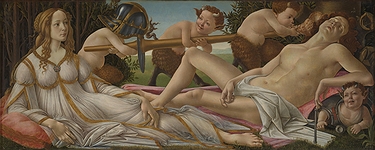
that Venus, as the lover of Mars, played a role in the origin of the
Roman people. This idea was reinforced by the legend of Aeneas, whose
long journeys and eventual settlement in Italy held great significance
for the Romans.
Aeneas was the son of Anchises and Aphrodite (whom the Romans identified
with Venus), and the Romans
believed that the Julian line, into which Augustus and his heirs were
adopted, traced its ancestry back to Aeneas’ son Iulus, and
therefore to the goddess Venus herself. Venus played a vital role
in protecting Aeneas: she guided him out of the flames of Troy, shielded
him from Juno’s hostility, and even prompted Queen Dido of Carthage
to fall in love with him, offering sanctuary during his trials. In
his final confrontation with Turnus, Venus intervened once more, restoring
the spear that had become lodged in a tree trunk.
At Lavinium there was a sanctuary of Venus that served all of Latium,
with ceremonies performed by the people of Ardea, though its age cannot
be determined. In Rome, several details indicate that Venus was worshipped
from an early period. A stone chapel with an image of Venus Murtea
or Murcia stood in the Circus, near the site of the concealed altar
of Census. The surname Murtea or Murcia shows that the myrtle tree
was associated with the goddess, and it is said that in ancient times
a myrtle grove stood in front of her sanctuary below the Aventine.
Some ecclesiastical writers, however, interpreted Murcia as meaning
‘stupid’ or ‘dull’ (from murcus). Another
ancient surname of Venus was Cloacina, which, according to Lactantius,
came from her image being found in the great sewer (cloaca) and set
up by the Sabine king Titus Tatius in a temple near the forum. Since
Venus was not a goddess of the underworld, this story seems to be
an etymological inference from the name. Cloaca is linked with cluere,
Cluilia, Cloelia, and luere (to purify), and there is a tradition
that after the war caused by the rape of the Sabine women, Titus Tatius
and Romulus ordered their people to purify themselves before the image
of Venus Cluacina. This fits the ancient belief that Titus Tatius
founded marriage; Venus Cloacina therefore presided over and purified
sexual relations within marriage. A third ancient surname was Calva,
under which she had two temples near the Capitol. Some thought one
had been built by Ancus Marcius because his wife risked losing her
hair; others believed it commemorated Roman women who, during the
Gallic siege, cut their hair to make bowstrings for the men; others
linked it to the whims of lovers, as calvere means ‘to bare
the head’. It most likely refers to the bride cutting a lock
of hair, either literally or symbolically, to dedicate it to Venus
on her wedding day. In these oldest surnames of Venus, we can see
her original nature and attributes. Over time, her worship expanded
considerably, and her identification with the Greek Aphrodite brought
new qualities to her character. At the start of the Second Punic War,
the worship of Venus Erycina or Erucina was introduced from Sicily,
and a temple was built on the Capitol, later joined by another outside
the Colline Gate. In 114 BC, a Vestal virgin was struck by lightning,
and her body was found naked. The disaster was attributed to widespread
moral corruption, especially among the Vestals, so the Sibylline books
were consulted, which instructed the construction of a temple to Venus
Verticordia—the goddess who turns the hearts of men—on
the Via Salaria. After the Samnite War, Fabius Gurges established
the worship of Venus Obsequens and Postvota, while Scipio Africanus
the Younger founded that of Venus Genitrix, later followed by Caesar,
who added Venus Victrix. The origins of Venus Militaris, Barbata,
and Equestris are unknown, but the sanctuaries of Venus Rhamnusia,
Placida, and Alma are all comparatively recent. Venus was also believed
to preside over gardens.
Daughter of Jupiter and Dione, she was sometimes said to be the wife
of Vulcan, with issue, and also had issue by Mars.