A Banquet of the Gods
Oil on copper, 20.5 x 15.5 cm, by Joachim Anthonisz. Wtewael
Location unknown
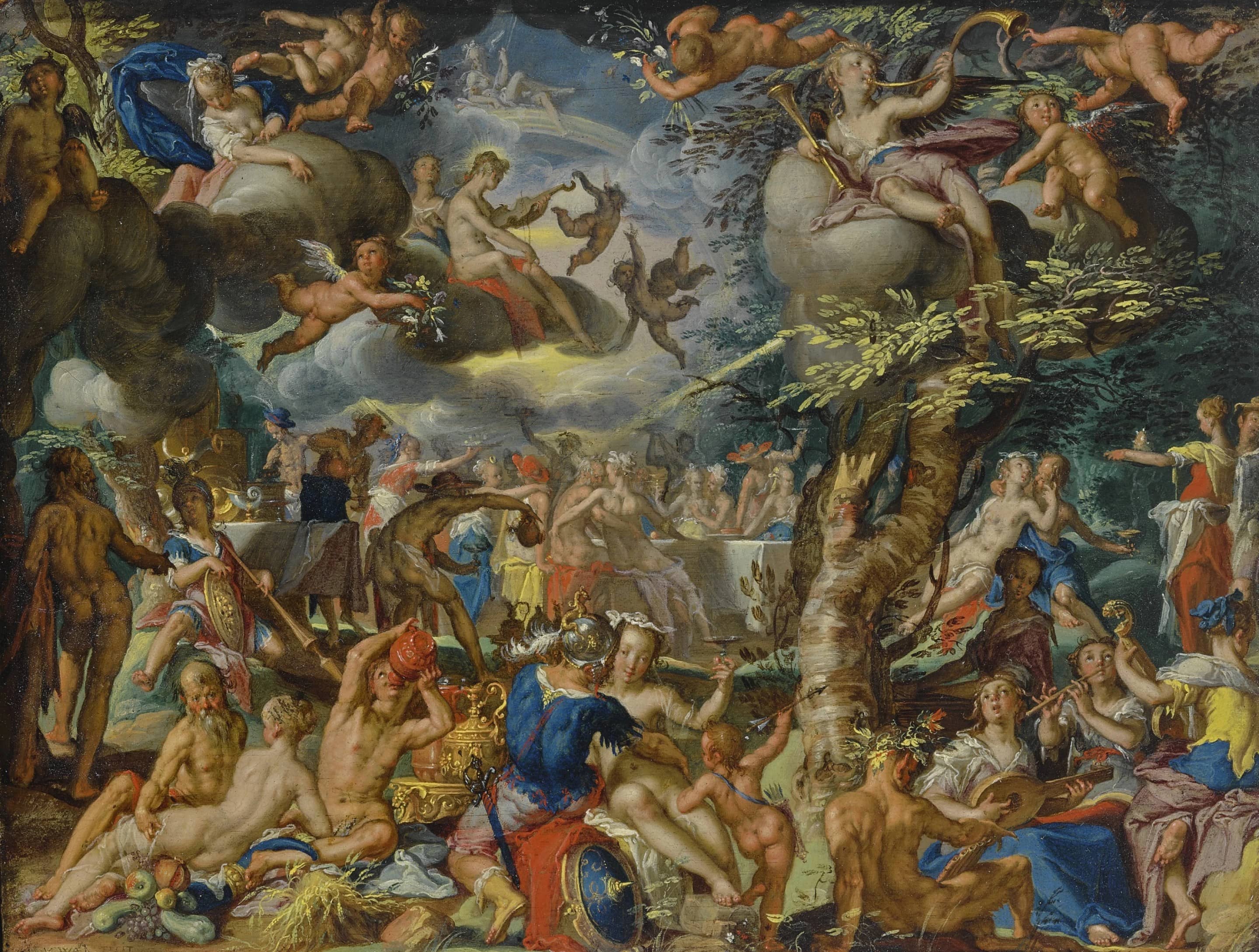
This work is a prime example of Dutch Mannerist art. Its elegant
forms, classical subject, and refined technique embody this
movement, which featured the most significant artists in the
Netherlands from 1580 to 1620. Wtewael earned high praise from his
peers for his remarkable versatility and artistic prowess. He
demonstrated a capacity to work across various mediums and scales,
yet it was his diminutive paintings that garnered the most acclaim.
This particular artwork exhibits his exceptional skill with fine
brushstrokes and vibrant colours on a reflective copper surface,
highlighting his extraordinary craftsmanship. The painting vividly
illustrates the artist’s imaginative narrative skill. Inspired by a
renowned print by Hendrick Goltzius, it features nearly fifty
elegantly arranged figures in a kaleidoscope of hues, gathered for a
celestial feast within a serene glade and atop a complex arrangement
of clouds. Dominating the foreground is a captivating frieze of
gods, intermittently disrupted by the sturdy trunk of a birch tree
ascending through the scene. At the bottom-centre of the scene,
Mars, the war god, embraces the reclining Venus, draped in
translucent fabric and cradling a delicate wine glass in her left
hand. To her left rests Cupid, leaning against her leg with his
trademark arrows. On their left, Bacchus indulges in wine from a
crimson jug, while Ceres reclines near him, her cornucopia
scattering wheat and goods before her. The figure on her left has not been identified, though it may be Saturn or Pluto. Pan, sits
in the right foreground with his pipe. He is surrounded by muses
playing instruments, with waiters to the gods positioned above them.
A birch tree with a curved form rises nearby, mirroring the postures
of many figures. Fame sits atop the tree with her trumpet,
surrounded by putti amidst swirling clouds. Hercules stands guard
with his club at the left edge. Minerva, in armour, sits beside
another tree, partially obscured by clouds. Luna observes the scene
from the upper left corner as she leans over a cloud. Apollo,
playing his instrument, hovers above the central feast. Above him is
Iris reclining on a rainbow. The figures at the banquet table remain
largely unidentified, although Diana, with her crescent moon on her
head, can be seen with her arm around Mercury. Behind them is
Ganymede pouring wine. This painting had previously been identified
as The Wedding of Peleus and Thetis and The Wedding of
Cupid and Psyche, but this has since proved to be erroneous.
 Possibly
Jan Nicquet, or his son, Amsterdam, c. 1604
Possibly
Jan Nicquet, or his son, Amsterdam, c. 1604