|
|
|
|||||||||
 |
||||||||||
| Monument to Álvaro Obregón | ||||||||||
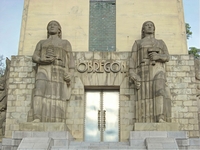
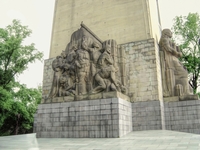
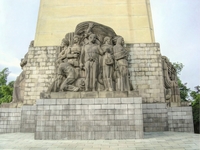
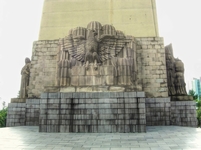
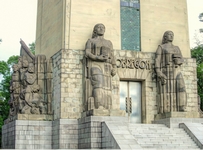
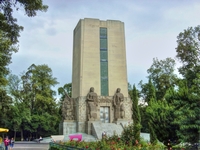
| The monument to President Álvaro Obregón, an Art Deco architectural work by Enrique Aragón Echegaray with Socialist Realist sculpture by Ignacio Asúnsolo, was built on the site of his assassination, the former La Bombilla restaurant. The area is now Bombilla Park in the neighbourhood of San Ángel, Mexico City. The assassination occurred on 17 July 1928 at the hands of a religious fanatic after Obregón was re-elected president for a second term. The monument has a square plan that narrows as it rises to form an obelisk. Three of its sides bear monumental reliefs, and the front features two colossal figures representing Fertility and Labour. These figures flank two steel doors adorned with large ornamental chains that form part of the locking mechanism. A wide stone stairway leads to the entrance. The interior has an octagonal plan, with the walls and floors clad in pink, grey, and black Italian and Mexican marble. The central feature is an altar with a bronze statue of Obregón by Asúnsolo, accompanied by two other statues representing his followers. At the centre of the chamber, a marble staircase leads to a lower level, where marble again decorates the walls and floors, complemented by bronze supports and various reliefs. The focal point is a glass cover over the exact spot where Obregón was murdered, accompanied by an inscription that reads: 'I die blessing the Revolution. Santana del Conde, Guanajuato, 3 June 1915. Here, 17 July 1928.' The original bullet holes are preserved in the floor. A niche in the wall holds a bronze sculpture of the president's arm, lost in battle in 1915, along with the actual arm preserved in a jar of formaldehyde, though in poor condition. Near the main altar, a small door leads to a narrow spiral staircase, which in turn leads to a lookout with views of San Ángel. Construction of the monument began in June 1934, and it was completed and inaugurated on 17 July 1935, the seventh anniversary of Obregón's assassination. It was completed hastily and built shorter than planned. Owing to a lack of funds, it was never finished as intended. It has thus been described as 'a mutilated commemoration of a mutilated hero'. | ||||||||||
| |
||||||||||
|
|
||||||||||
| |
||||||||||
 |
||||||||||