

Amazon
Ads |


(c. 4 AD-c. 28)
Biographical
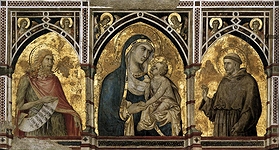
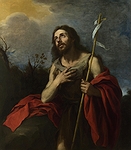
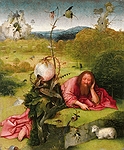
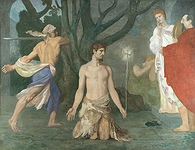
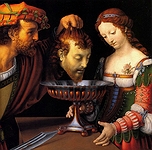
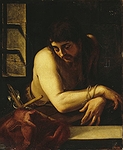
John the Baptist, is, in the Bible, the 'forerunner' of Jesus in the Gospel story. By his preaching and teaching, he evidently made a great impression upon his contemporaries. According to the birth-narrative embodied in Luke 1 and 2, he was born in a city of Judah, in the hill country (possibly Hebron), of priestly parentage. His father Zacharias was a priest of the course of Abijah, and his mother Elizabeth, who was also of priestly descent, was related to Mary, the mother of Jesus, whose senior John was by six months. This narrative of the Baptist’s birth seems to embody some very primitive features, Hebraic and Palestinian in character, and possibly at one time independent of the Christian tradition. In the apocryphal gospels John is sometimes made the subject of special miraculous experiences (e.g. in the Protevangelium Jacobi, ch. xxii., where Elizabeth fleeing from Herod’s assassins cried: 'Mount of God, receive a mother with her child', and suddenly the mountain was divided and received her). In his 30th year (15th year of the emperor Tiberius, AD 25–26?) John began his public life in the wilderness of Judaea, the wild district that lies between the Kedron and the Dead Sea, and particularly in the neighbourhood of the Jordan, where multitudes were attracted by his eloquence. The central theme of his preaching was, according to the Synoptic Gospels, the nearness of the coming of the Messianic kingdom, and the consequent urgency for preparation by repentance. John was evidently convinced that he himself had received the divine commission to bring to a close and complete the prophetic period, by inaugurating the Messianic age. He identified himself with the 'voice' that was prophesised by Isaiah. Noteworthy features of his preaching were its original and prophetic character, and its high ethical tone, as shown e.g. in its anti-Pharisaic denunciation of trust in mere racial privilege. Herein also lay, probably, the true import of the baptism which he administered to those who accepted his message and confessed their sins. It was an act symbolising moral purification by way of preparation for the coming 'kingdom of heaven', and implied that the Jew so baptised no longer rested in his privileged position as a child of Abraham. John’s appearance, costume, and habits of life, together with the tone of his preaching, all suggest the prophetic character. He was popularly regarded as a prophet, more especially as a second Elijah. His preaching awoke a great popular response, particularly among the masses of the people, 'the people of the land'. He had disciples who fasted, who visited him regularly in prison, and to whom he taught special forms of prayer. Some of these afterwards became followers of Christ. John’s activity indeed had far-reaching effects. It profoundly influenced the Messianic movement depicted in the Gospels. The preaching of Jesus shows traces of this, and the Fourth Gospel (as well as the Synoptists) displays a marked interest in connecting the Johannine movement with the beginnings of Christianity. The fact that after the lapse of a quarter of a century, there were Christians in Ephesus who accepted John’s baptism is highly significant. This influence also persisted in later times. Christ’s estimate of John was a very high one. He also pointedly alludes to John’s work and the people’s relation to it, in many sayings and parables (sometimes in a tone of irony). The duration of John’s ministry cannot be determined with certainty: it terminated in his imprisonment. Herod Antipas had taken to himself Herodias, the wife of his brother, Philip; and when John reproved him for this and other sins, Herod cast him into prison. The place of his confinement was the castle of Machaerus, a fortress on the eastern shore of the Dead Sea. At this castle, a court-festival was kept in honour of Herod's birthday. After supper Salome, the daughter of Herodias, came in and danced before the company, and by her grace of manner and beauty of person so charmed Herod that he promised with an oath to give her whatsoever she should ask. Salome, prompted by her vicious and vindictive mother, demanded the head of John the Baptist. Herod gave the order to an officer of his guard, who went immediately to the prison-vault where John was confined, and soon returned bearing on a large dish the ghastly face and head of the murdered man. His death cannot with safety be placed later than AD 28. In the church calendar, this event is commemorated on the 29th of August. According to tradition, John the Baptist was buried at Samaria. He is the patron saint of baptism, conversion, farriers, monastic life, and tailors.



© 2024 The Universal Compendium