
|
|
 (2857) |
|
||||||||
| George
III
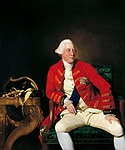
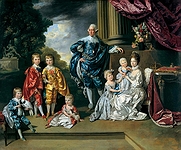
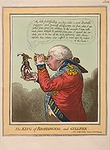
King of Great Britain and Ireland (1760–1820) Other names: George William Frederick Biographical King of Hanover 1815–20† Elector of Hanover 1760–1807 dep; 1813–15 Prince of Wales 1751–60 2nd Duke of Edinburgh 1751–60 2nd Marquess of the Isle of Ely 1751–60 Earl of Chester 1751–60 2nd Viscount Launceston 1751–60 2nd Baron Snowdon 1751–60 Defender of the Faith 1760–1820† Knight of the Garter 1750 (England) George III was raised under the strict guidance of his mother and the Earl of Bute after his father’s death in 1751, and was moulded by the ideals of the 'Patriot King' seeking to challenge the long-standing dominance of the Whig aristocracy. Educated in seclusion and resolute in purpose, he came to the throne in 1760, married Queen Charlotte in 1761 (he was crowned at Westminster Abbey that year), and aimed to govern not through popular ministers like Pitt but by reasserting the crown’s authority. Though he initially succeeded in removing Pitt and making peace with France, his rule soon became mired in conflict with Whig factions and unstable ministries, prompting him to cultivate a loyal cadre known as the 'king’s friends'. The crisis over taxing the American colonies offered him a chance to galvanise national sentiment, and from 1770, with Lord North as prime minister, George pursued the war with conviction, believing the colonies owed full obedience. Despite early support, setbacks like Saratoga and Yorktown shifted the political winds, leading to North’s resignation in 1782 and a negotiated peace with America. Even so, George resisted Whig dominance, dismissing the Fox-North coalition in 1783 and bringing in the young Pitt, whose subsequent electoral victory affirmed the king’s ability to influence government. Though Pitt’s popularity soon surpassed the monarch’s, George’s moral seriousness and domestic sobriety lent him enduring symbolic weight. He backed exploration, supported the Royal Academy, and pursued agriculture with earnest devotion under the pseudonym Mr Ralph Robinson. However, his reign darkened with recurring mental illness (possibly caused by porphyria), first in 1765, then more grievously in 1788, though he recovered under Dr Willis’s care. As the French Revolution engulfed Europe, George stood as a symbol of national stability, yet his rigid opposition to Catholic emancipation—rooted in his reading of his coronation oath—led to Pitt’s resignation in 1801. War resumed in 1803, renewing George’s popular standing, though his erratic health and the death of Pitt in 1806 forced him to accept Fox in a coalition, which soon collapsed over Catholic policy. The 1807 elections confirmed public support for George’s conservative principles, but by 1811, following the death of his daughter Amelia, his mind gave way entirely. Blind and insane, he lived out his final years at Windsor, dying in 1820 after nearly a decade of complete seclusion, having seen Britain through war, revolution, and the beginnings of modern political change, all while clinging to a vision of monarchy shaped more by duty than by the realities of a shifting constitutional age. Place of birth and baptism (1738): Norfolk House, St James' Square, London Place of marriage: St James' Palace, London Place of death: Kew Palace, London Place of burial: St George's Chapel, Windsor Castle Son of Frederick, Prince of Wales (Hanover) and Augusta of Saxe-Gotha, he married Charlotte of Mecklenburg-Strelitz in 1761, and had issue. |
||||||||||
| |
||||||||||
 |
||||||||||
| |
||||||||||
|
|


