
|
|
|
|||||||||
 |
||||||||||
| Portraits of 500 Arhats | ||||||||||
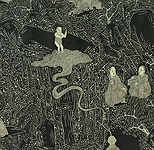
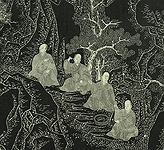
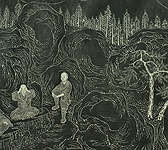
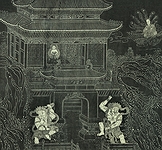
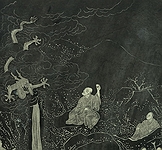
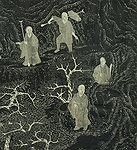
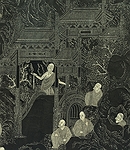
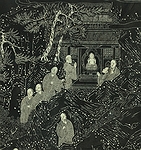
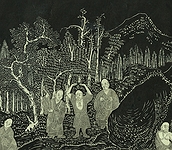
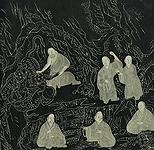
| Housed at the National Gallery, Beijing, Portraits of 500 Arhats is a large and detailed ink rubbing, rendered in varying shades of black ink on a continuous scroll, folded in an accordion style, and framed with yellow brocade. It depicts arhats—individuals who have achieved enlightenment (nirvana) in Buddhism—typically represented in groups of sixteen, eighteen, or 500, with with the latter being the earliest tradition. It is divided into ten sections, each bearing the name of one of the ten heavenly stems, or celestial stems, from the Chinese calendar. The work was written and inscribed by Emperor Gaozong of China (1711–99), who reigned as Qianlong from 1736 to 1796. Each section is accompanied by a text. The preface mentions the Emperor’s involvement in the creation of the work and describes the characteristics of the 500 arhats as they appear in their various positions throughout the painting. Rather than being arranged in rows, as is traditional, the arhats are depicted either moving or still, with varied expressions and gestures, set amid woods with streams, pavilions, terraces, temples, and bridges, in a lifelike manner. The work was originally a painting by Wang Fangyu, a skilled figure and landscape painter born in Wuxi, Jiangsu, who served as a court painter during Qianlong’s reign. His painting was engraved on stone in 1757 in the Hall of the Five Hundred Arhats on Longevity Hill in the Garden of Clear Ripples (now in Haidian District). Both the hall and the engravings have since been lost. This scroll painting is a first-generation rubbing from that engraving. | ||||||||||
| |
||||||||||
 |
||||||||||
|
|
||||||||||
| |
||||||||||
  |
||||||||||


