|
|
|
|||||||||
 |
||||||||||
| (M14) | ||||||||||
| Jesus
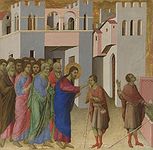
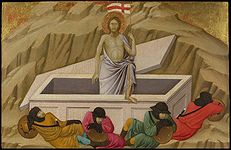
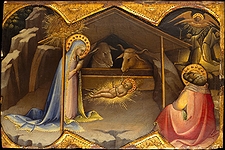
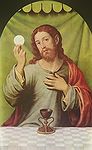
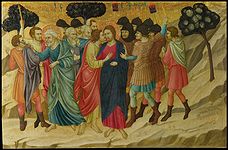
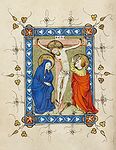
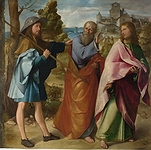
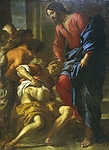
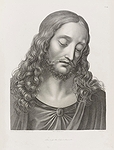
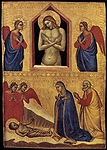
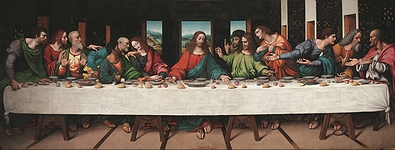
Christ (c. 6-4 BC-c. AD 30) Other names: Jesus of Galilee, Jesus of Nazareth Biographical The founder of Christianity, Jesus was born ‘the son of God ’ in Bethlehem, Judaea, according to the beautiful accounts in St Matthew’s and St Luke’s gospels, the first-born child of the Virgin Mary of the tribe of Judah and descendant of David and wife of Joseph, a carpenter. The birth took place in a stable, because on their way to Joseph’s home town, Nazaretli, in order to comply with the regulations for a Roman population census, they found 'there was no room for them at the inn'. According to St Matthew, Jesus’ birth took place just prior to the demise of Herod the Great (4 BC), but the Roman census referred to by St Luke did not take place before AD 6. The only biographical sources are the four gospels of the New Testament of the Bible, of which St Mark, containing the recollection of Peter, is the oldest, therefore most reliable, and it has been estimated that their entire compass cover only fifty days in the life of Christ. But he is also mentioned by Tacitus, Suetonius and Josephus and in certain anti-Christian Hebrew writings of the time. Little is written of his early boyhood and manhood. He is believed to have followed Joseph’s trade of carpentry, but at the age of twelve we are told how his astonished mother saw him knowledgeably discoursing with the scribes, being assured by him that he was about his 'father’s business'. But nearly eighteen years passed in obscurity, before his baptism at the hands of his cousin, John the Baptist, gave him the first divine intimation of his mission. After forty days in the wilderness wrestling successfully with all manner of temptations, he gathered around him twelve disciples and undertook two missionary journeys through Galilee culminating in the miraculous feeding of the live thousand (Mark vi, 30-52), which seen through the eyes of Herod, John the Baptist's executioner, had obvious dangerous political implications. Furthermore, Jesus' association with 'publicans and sinners', his apparent flouting of traditional religious practices, the performance of miracles on the Sabbath, the driving of the moneylenders from the temple, and the whole tenor of his revolutionary Sermon on the Mount (Matthew v-vi), that inspiring breviary of Christian ethics, emphasising love, humility, meekness and charity, roused the Pharisees. Christ and his disciples sought refuge for a while in the Gentile territories of Tyre and Sidon, where he secretly revealed himself to them as the promised Messiah, and hinted beyond their comprehension at his coming passion, death, and resurrection. According to Mark, he returned to Jerusalem in triumph, a week before the Passover feast, and after the famous 'Last Supper' with his disciples, was betrayed by one of them, Judas lscariot, by a kiss and after a hurried trial condemned to death by the Sanhedrin. The necessary confirmation of the sentence from Pontius Pilate, the Roman procurator, was obtained on the grounds of political expediency and not through any proof of treason implicit in any claim to territorial kingship by Christ. Jesus was given into the hands of the mob incited by the Pharisees, and, deserted by his followers, was crucified early on either Friday 7 April, 30, or 3 April, 33, depending on the estimate taken of the duration of his ministry. These vary from six months to two years or more. The instrument of crucifixion, the cross, became the symbol of Christianity. The following Sunday, according to all four gospels, the disciples hiding away in an 'upper room' suddenly took courage through receipt of the 'Holy Ghost' and several revelations that Christ 'had risen from the dead' and would continue his leadership forever. The history of the church begins here with the Acts of the Apostles in the New Testament. The apostolic succession enshrined in the Roman Catholic Church begins with Christ’s public declaration to Peter (Matthew xvi, 17-19) that on him, he will build his church. Roman persecutions only served to strengthen her. In the 4th century at Niceae, Christian theologians incorporated Platonic metaphysics into their theology. Roman empires in East and West became Christianised, but with distinctive liturgies formally separating in the 11th century, although the Nicene creed serves as a basis for both. Rome until the 16th century was the hub of western Christianity when the reformatory movements of Calvin, Luther, and Knox, allied to local nationalism, split the western church into an increasing number of sects, depending for their individual authority on multifarious interpretations of the New Testament, but all united in their opposition to papal supremacy. But a growing movement for church reunion was initiated at the beginning of the 20th century. Place of birth: Bethlehem Place of death: Jerusalem Son of Mary and Joseph, or the Son of God in Christian belief. |
||||||||||
| |
||||||||||
| |
||||||||||
 |
||||||||||
|
||||||||||