|


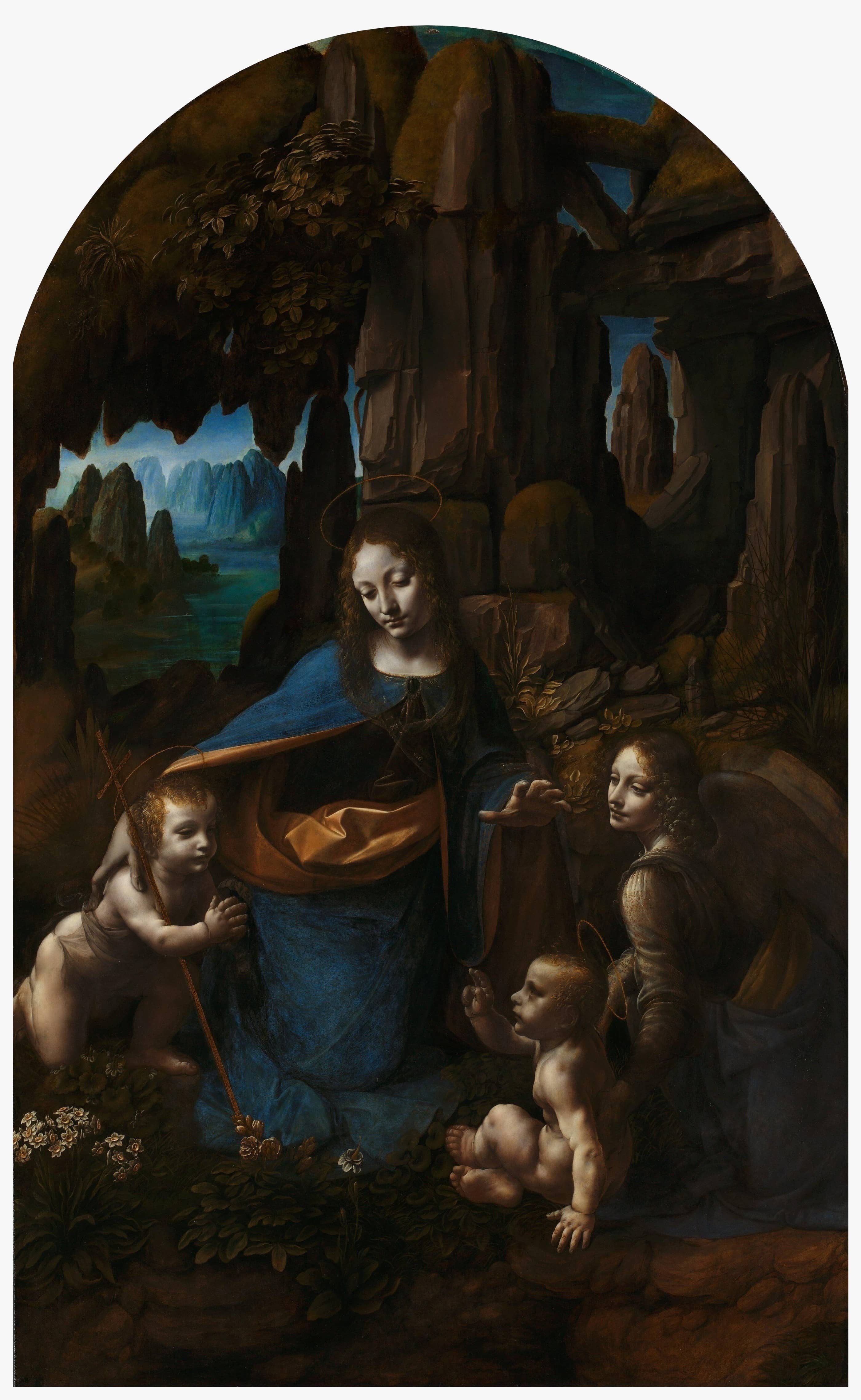
The Virgin of the Rocks
Oil on panel, 189.5 × 120 cm, by
Leonardo
da Vinci, c.
1506–08
The National Gallery, London
In 1483, da Vinci was commissioned in Milan, along with the de Predis
brothers, to provide three paintings for an altarpiece, with da Vinci
tasked to paint the Virgin and Child. He commenced his portrait, but in
1499, he left Milan after the French captured the city. He later
returned and completed it in 1508. Da Vinci's figures in his portrait
are arranged in a pyramidal composition, a common technique of the
period, to create a sense of balance and stability. He further
emphasises this harmony by using subtle gestures and eye contact to
connect the figures within the scene. They are masterfully situated
within a mystical grotto, a secluded haven formed by towering rocks and
a glistening pool of water. The interplay of light and shadow creates a
sense of depth and realism, and imbues the scene with an air of mystery
and drama. Two paintings of the Virgin of the Rocks by da Vinci
exist, with the Louvre version traditionally considered the earlier
work. Historians debated their origin, with theories suggesting either
separate altarpieces or, more commonly, the London version replacing the
Louvre version due to financial disputes and potential changes requested
by patrons. However, infrared studies in 2005 and 2009 revealed
significant differences, disproving the substitution theory. The
underdrawing for this version reveals that da Vinci originally intended
a different design, but clearly decided to create a similar picture to
the picture held at the Louvre.


|
|
|