|


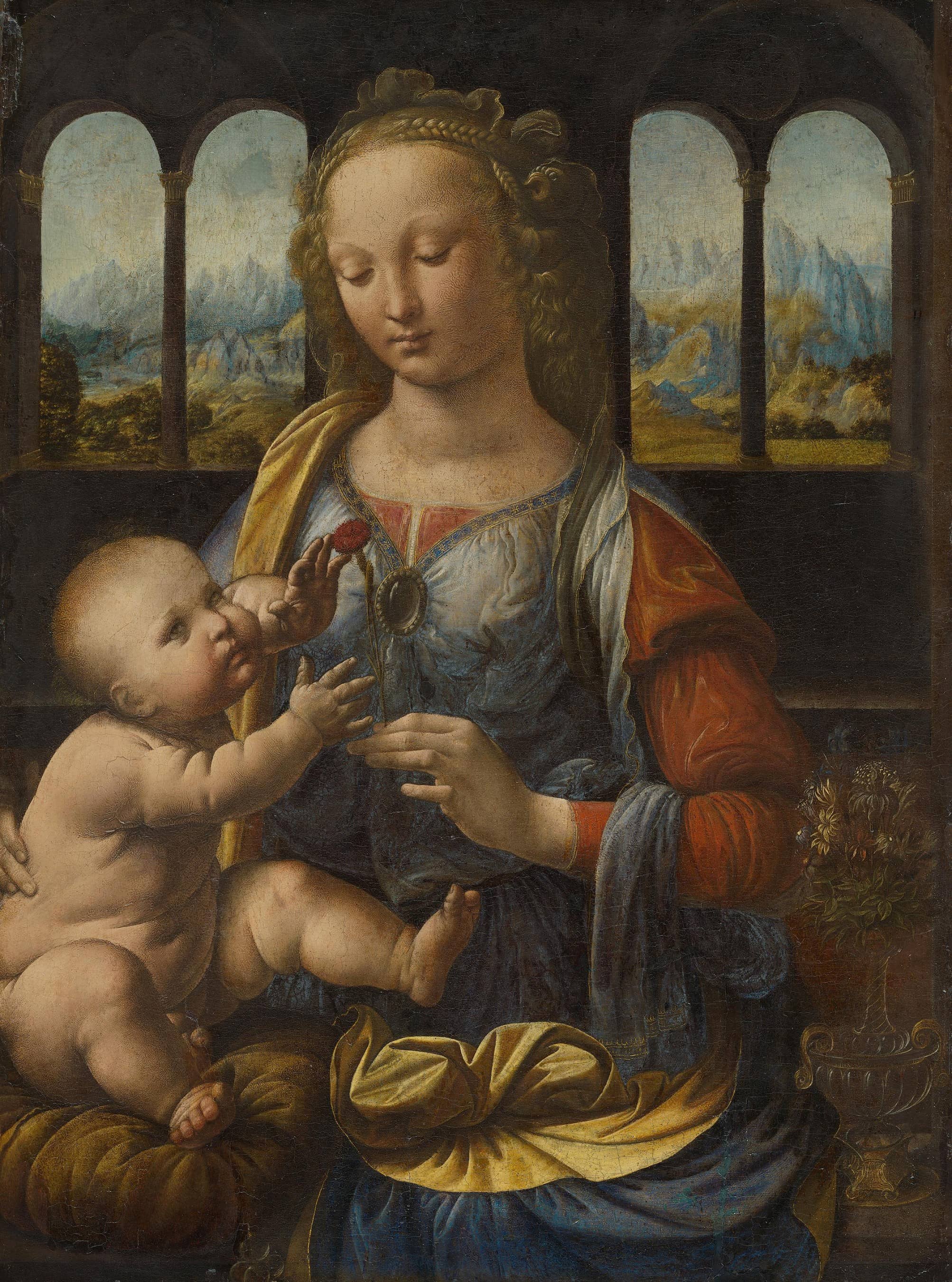
Madonna of the Carnation
Oil on panel, 62 x 48.5 cm, by
Leonardo
da Vinci, c. 1475
Alte Pinakothek, Munich
This work is thought to be da Vinci's first independent painting.
The subject of the
Virgin offering a carnation to the Christ Child was popular in Florence
between the 1400s and 1500s, the carnation being a symbol of love and
sacrifice. The mountainous landscape seen through the windows is unusual
because no such views are found in Central Italy.
Previously attributed to da Vinci's teacher, Verrocchio, this painting
is now generally accepted as having been completed by da Vinci when he
was still working in his teacher's workshop, but possibly with
overpainting by another artist. Those still in doubt point to a slight
rigidity in the figures compared to da Vinci's usual mastery of form and
movement. Additionally, the light and shadow effects, while present,
seem less nuanced and layered than in his established works. However,
this could be attributed to his early experimentation, as he was still
developing and mastering his techniques. Some have suggested that
Verrocchio contributed to the original design because works by other of
his students share similarities to da Vinci's, although this would be
inevitable because designs and studies were usually shared amongst young
artists in the same studio. With regard to painting technique, this work
is regarded as an experiment, but still of remarkable artistic genius.

|
|
|