|


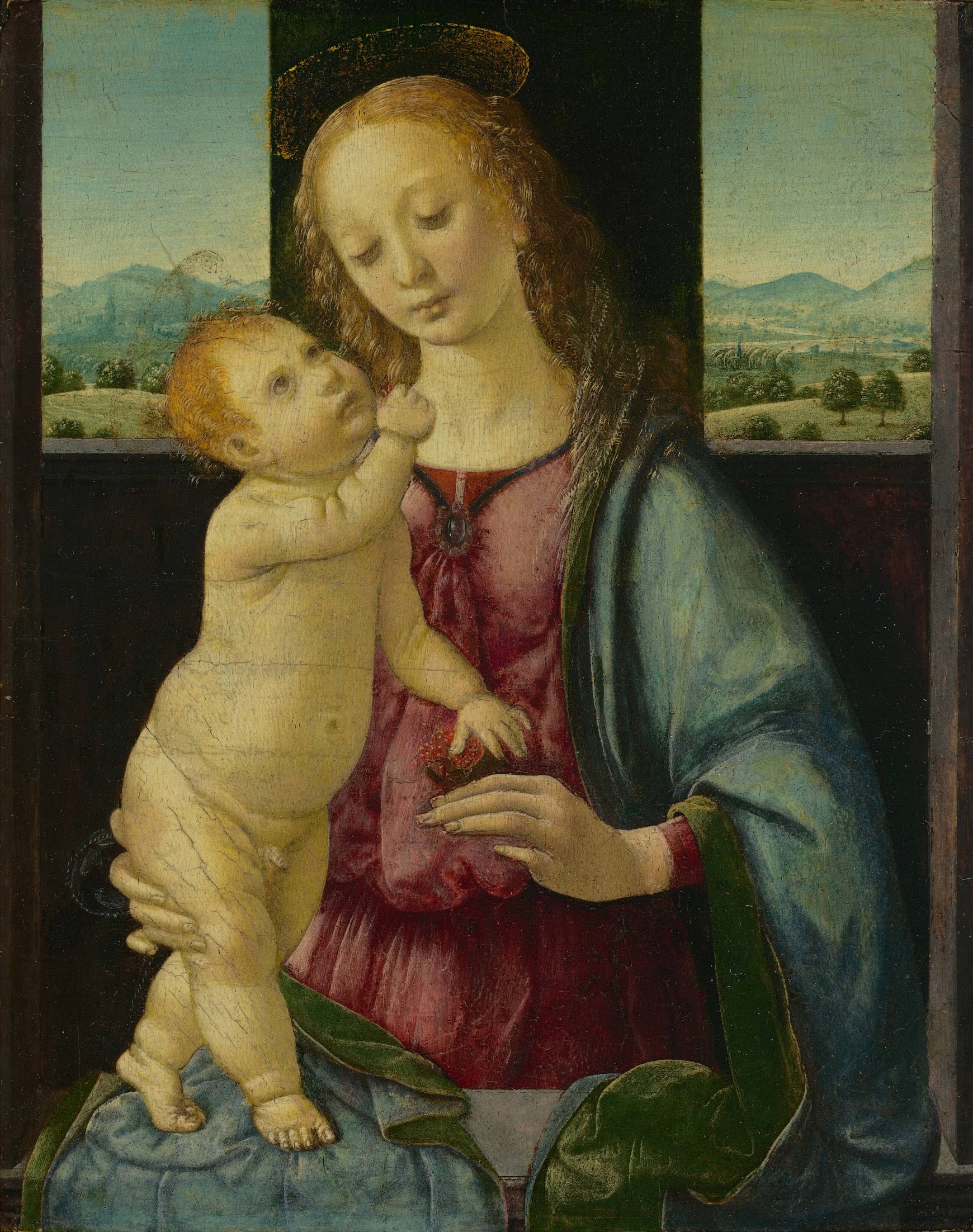
Madonna and Child with a Pomegranate/Dreyfus Madonna
Oil on panel, 16.5 x 13.4 cm, attributed to
Leonardo
da Vinci, or Lorenzo di Credi, 1475–80
National Gallery of Art,
Washington
This portrait shows the Virgin seated with the Christ child standing on
her lap, as she offers him a broken pomegranate. In Christian symbolism,
this fruit represents fertility, abundance, and the promise of new life,
however, some art historians believe the pomegranate holds a deeper
meaning. Its numerous seeds might foreshadow the future passion and
suffering of Christ. The painting's key point of contention is its
attribution. Art historians debate whether it is the work of da Vinci
himself, or a highly skilled follower imitating his early style. It is
currently attributed to Lorenzo di Credi by most scholars. He worked in
the shop of Andrea del Verrocchio, at the same time as da Vinci, which
would explain the similarity in style between the two students.
Proponents of da Vinci's authorship cite the use of sfumato and the
Virgin's characteristic bent finger. However, critics argue that the
painting, particularly the Christ child, lacks the anatomical precision
and compositional harmony typically found in da Vinci's works. The
attribution to di Credi is based on stylistic similarities with his
documented paintings. The portrayal of the Christ child and the overall
composition align more closely with his style. Also, it is argued that
the painting's small size is more typical of workshop productions during
the Renaissance, where assistants would create devotional pieces based
on the master's designs. Adding to the mystery is the painting's medium.
While da Vinci would later become famous for his oil painting
techniques, this work utilises tempera, a more common medium at the
time. If he is indeed the author of this painting, it would indicate the
work predates his experimentation with oils.

|
|
|