|
|
|
|||||||||
 |
||||||||||
| (M10-N) | ||||||||||
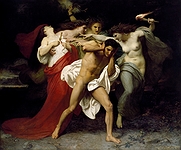
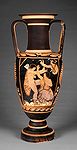
| Orestes King of Mycenae Other titles King of Argos King of Sparta Biographical According to the Homeric account, Agamemnon, on his return from Troy, did not see his son Orestes, as he was murdered by Aegisthus and Clytemnestra before having the chance. Eight years after his father's death, Orestes travelled from Athens to Mycenae, where he killed his father's murderer. He also performed the burial rites for Aegisthus and his mother, and gained great fame for avenging his father. This basic outline of Orestes' story has been expanded upon and embellished by tragic poets. It is said that when Agamemnon was murdered, there were plans to kill Orestes as well, but his sister Electra secretly entrusted him to a slave, who took him to Strophius, king of Phocis and brother-in-law to Agamemnon. Some versions suggest Orestes was saved by his nurse, Geilissa, or by Arsinoe or Laodameia, who allowed Aegisthus to kill her own child, believing it to be Orestes. In Strophius' house, Orestes grew up alongside the king's son, Pylades, and the two formed a close friendship, which became proverbial. Urged by messengers from Electra to avenge his father's death, Orestes consulted the oracle of Delphi, which supported his plan. He then secretly made his way to Argos, disguised as a messenger from Strophius bringing the ashes of Orestes, and visited his father's tomb. After sacrificing a lock of his hair, he revealed his identity to his sister Electra, who was mistreated by Aegisthus and Clytemnestra. Together, they quickly enacted their plan, and both Aegisthus and Clytemnestra were killed in the palace. Afterward, Orestes was seized by madness, and he fled, pursued by the Erinnyes of his mother. Sophocles does not mention this madness as an immediate consequence of the murder, ending his tragedy where Aegisthus meets his death. However, according to Euripides, Orestes not only became mad but, when the Argives demanded his and Electra's deaths, and Menelaus refused to help, he and Pylades killed Helen, her body later being taken by the gods. Orestes also threatened Menelaus with the death of his daughter, Hermione, but Apollo intervened, resolving the conflict. Orestes betrothed himself to Hermione, and Pylades to Electra. According to the most common account, Orestes wandered from land to land, pursued by the Erinnyes. He took refuge with Athena in Athens, where the goddess protected him and appointed the Areopagus court to decide his fate. The Erinnyes accused him, but he defended himself by invoking the command of the Delphic oracle. The court, divided in its vote, acquitted Orestes by Athena's command, and he dedicated an altar to Athena Areia. In another version of the legend, Orestes consulted Apollo for a cure to his madness and constant wandering. The god instructed him to go to Tauris in Scythia to fetch the image of Artemis, which had fallen from heaven, and take it to Athens. Orestes and Pylades went to Tauris, where they were captured by the locals to be sacrificed to Artemis. However, Iphigeneia, the priestess of Artemis, was Orestes’ sister. After recognising each other, the three of them escaped with the statue. Upon returning, Orestes claimed his father's kingdom in Mycenae, which had been taken by Aletes or Menelaus. When Cylarabes of Argos died without heirs, Orestes also became king of Argos. The Lacedaemonians made him their king because they preferred him, the grandson of Tyndareus, over Menelaus’ sons, Nicostratus and Megapenthes, born of a slave. Orestes’ power grew as the Arcadians and Phocians allied with him, and he is said to have led colonists from Sparta to Aeolis, founding the town of Argos Oresticum in Epirus during his period of madness. In his reign, the Dorians under Hyllus invaded the Peloponnesus. Orestes died from a snakebite in Arcadia, and his body was transported from Tegea to Sparta, in accordance with an oracle. During a truce between the Lacedaemonians and Tegeatans, Lichas of Sparta found Orestes' remains in Tegea or Thyrea in the house of a blacksmith. He took them to Sparta, where an oracle had stated that Sparta could not win unless it possessed Orestes’ remains. According to an Italian version of the legend, Orestes brought the image of Taurian Artemis to Aricia, from where it was later carried to Sparta. Orestes was buried at Aricia, and his remains were eventually taken to Rome. Place of burial: Sparta Son of Agamemnon and Clytemnestra, he was married to Hermione and Erigone, with issue by both. |
||||||||||
| |
||||||||||
| |
||||||||||
 |
||||||||||