Amazon
Ads |


St
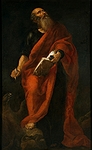
John the Evangelist
(c. 6–c. 100)
Other names: John the Apostle,
John Boanerges,
John the Divine,
John of Patmos
Biographical
Previously a fisherman,
St John the Evangelist is traditionally credited with authoring the Gospel
of John, the three Epistles of John, and the Book of Revelation,
and he played a pivotal role in shaping Christian theology and spirituality.
He was born in Galilee to Zebedee,
a fisherman, and Salome,
and he and his brother James
were among the first disciples summoned by Jesus.
John's close bond with Jesus is evident throughout the Gospels, as he
was present at significant events such as the Transfiguration, the Last
Supper, and the Crucifixion. Following Jesus' death and resurrection,
John emerged as a prominent leader within the early Christian community.
He embarked on extensive missionary journeys, spreading the gospel and
establishing churches across the Mediterranean region.
He possibly went to Ephaesus and found the Christian community there.
John was the only apostle not to die a martyr, although he was imprisoned
with Peter by Herod Agrippa I sometime between 42 and 44 for preaching
the gospel in Samaria. In 95, he was again arrested and taken to Rome
as a prisoner, but was released in 96 after the Emperor Domitian's death.
His longevity enabled him to serve as a mentor and guide for the growing
Christian movement.
John's literary contributions to the New Testament stand as a testament
to his profound understanding of Christian faith.
He
is the patron saint of art dealers, bookbinders, booksellers, compositors,
engravers, against poison, printers, painters, sculptors, theologians,
writers, Asiatic Turkey, and Taos in New Mexico.
Place of birth: Galilee
Place of death: Ephesus
Place of burial: Ephesus


© 2024 The Universal Compendium