
Amazon
Ads |


(–44)
Other names: Iago, Boanerges
Biographical
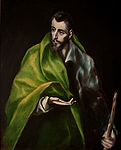
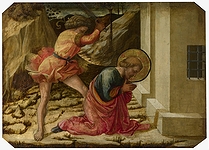
One of the twelve apostles, James was the son of Zebedee and Salome, who were likely people of means, and the brother (probably the elder of the two) of John the Evangelist. He was named 'the Greater' to distinguish him from the Apostle James 'the Less', who was probably shorter of stature. We know nothing of James' early life. It is probable, according to Acts 4:13, that John (and consequently his brother James) had not received the technical training of the rabbinical schools; in this sense they were unlearned and without any official position among the Jews. But, according to the social rank of their parents, they must have been men of ordinary education, in the common walks of Jewish life. They had frequent opportunity of coming in contact with Greek life and language, which were already widely spread along the shores of the Galilean Sea. Although some authors claim that the Virgin Mary and James' mother, Salome, were sisters, the relationship remains doubtful. The Galilean origin of James in some degree explains the energy of temper and the vehemence of character which earned for him and St John the name of Boanerges (sons of thunder); the Galilean race was religious, hardy, industrious, brave, and the strongest defender of the Jewish nation. When John the Baptist proclaimed the kingdom of the Messiah, St John became a disciple, and afterwards brought his brother James to the Messiah. Several incidents scattered through the Synoptics suggest that James and John had that particular character indicated by the name 'Boanerges', given to them by Jesus; they were burning and impetuous in their evangelical zeal and severe in temper. The two brothers showed their fiery temperament against 'a certain man casting out devils' in the name of the Christ; John, answering, said: 'We forbade him, because he followeth not with us'. When the Samaritans refused to receive Christ, James and John said: 'Lord, wilt thou that we command fire to come down from heaven, and consume them?' On the last journey to Jerusalem, their mother Salome said to Jesus: 'Say that these my two sons may sit, the one on thy right hand, and the other on thy left, in thy kingdom'. And the two brothers, still ignorant of the spiritual nature of the Messianic Kingdom, joined with their mother in this eager ambition. And on their assertion that they are willing to drink the chalice that Jesus drinks of, and to be baptised with the baptism of his sufferings, Jesus assured them that they will share his sufferings. James was martyred fourteen years after this prophecy, AD 44. Herod Agrippa I reigned at that time as king over a wider dominion than that of his grandfather. His great object was to please the Jews in every way, and he showed great regard for the Mosaic Law and Jewish customs. In pursuance of this policy, on the occasion of the Passover of AD 44, he perpetrated cruelties upon the Church, whose rapid growth incensed the Jews. The zealous temper of James and his leading part in the Jewish Christian communities probably led Agrippa to choose him as the first victim. 'He killed James, the brother of John, with the sword'. (Acts 12:1-2). According to a tradition, which, as we learn from Eusebius, was received from Clement of Alexandria (in his lost Hypotyposes), the accuser who led the Apostle to judgment, moved by his confession, became himself a Christian, and they were beheaded together. As Clement testifies expressly that the account was given to him 'by those who were before him', this tradition has a better foundation than many other traditions and legends respecting the Apostolic labours and death of James. According to another tradition, James preached Christianity in Spain, returned to Judea and was put to death by order of Herod; his body was miraculously translated to Iria Flavia in the northwest of Spain, and later to Compostela, which town, especially during the Middle Ages, became one of the most famous places of pilgrimage in the world. Another tradition states that James never left Jerusalem. James is the patron saint of apothecaries, knights, pilgrims, Chile, Guatemala, Nicaragua, Spain, and Spanish conquistadores.
Place of birth: Galilee
Place of death: Jerusalem
Place of burial (relics): possibly Compostela, Spain and Church of St-Saturnin, Toulouse


© 2024 The Universal Compendium