
|
|
|
|||||||||
 |
||||||||||
| (4175) | ||||||||||
Marie
Ragueneau
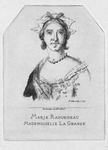
(1639–1727) Other names: Marotte Biographical Marie Ragueneau, the daughter of a Parisian bourgeois whose name appears in theatrical history through her father's association with Molière's troupe during its early tours of the provinces, was at that time the maid of honour to Catherine Leclerc, Mademoiselle De Brie, whose favour she had attracted. She later went on the stage and married La Grange, one of the troupe's most important actors. At the Palais-Royal, she performed character roles in comedy, the only roles for which she gained public approval. It is possible that she played the role of the Comtesse d'Escarbagnas, which tradition attributes to Marotte Beaupré, but this remains only a conjecture. Marie was considered physically unattractive and was nevertheless known for her flirtatious manner, which inspired the following epigram: |
||||||||||
|
||||||||||
After
Molière's death, she joined the Guénégaud troupe,
remained with it after the 1680 merger, and retired on 1 April 1692
with a pension of one thousand livres.
She later published the first edition of Molière's collected
works.
Daughter of Cyprien Ragueneau and Marie Brunet, she married Charles Varlet in 1672 and had issue. |
||||||||||
| |
||||||||||
 |
||||||||||
| |
||||||||||
 |
||||||||||


