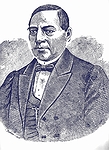
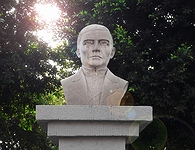
Benito
Juarez
(1806–72)
Other names: 'Glorious Son of the Americas'
Biographical
President of Mexico 1858–61, 1861–65, 1865–67, 1867–71,
1871–72†
President of the Supreme Court 1858
Minister of justice 1855
Governor of Oaxaca 1847–52
, 1856–57 (acting)
Director of the Institute of Sciences and Arts in Oaxaca
Federal deputy 1841
Member of the Oaxaca City council 1832
Benito Juárez rose from humble beginnings as an orphan of Mesoamerican
Indian parents to become one of Mexico’s most revered national
figures and president. He was a shepherd as a boy and, at thirteen,
was illiterate and spoke only Zapotec; he began to learn to read after
moving to the city of Oaxaca, where the priest Antonio Salanueva oversaw
his education.
He pursued law at the Oaxaca Institute of Arts and Sciences,
graduating in 1831, the same year he entered public service,
and by 1841, he was a civil judge
. A man of unwavering honesty and modesty, Juárez dedicated
his life to politics, advocating liberal reforms aimed at dismantling
the entrenched power of the Roman Catholic Church and the landed aristocracy
to foster capitalism and constitutional governance.
In 1848, he refused to support Antonio López de Santa
Anna after Santa Anna’s defeat in the Mexican-American War. When
Santa Anna sought refuge in Mexico, Juárez—then governor
of Oaxaca—declined to offer him protection or shelter. This defiance
angered Santa Anna's supporters and the conservative factions still
loyal to him. As a result, Juárez was imprisoned and subsequently
exiled to the United States.
He settled in New Orleans and planned the overthrow of the Santa
Anna government
after conservatives seized power, and after their defeat,
he returned in 1855 to play a crucial role in drafting laws
that curtailed ecclesiastical privileges, redistributed church lands,
enshrined civil authority,
and carrying out extensive legal reform with his 'Ley Juárez'.
In 1858, after Félix Zuloaga seized power and declared himself
president during the Reform War, Juárez fled Mexico City, but
returned in 1861 following the liberals’ victory.
Elected president again that year amid national turmoil, he
faced foreign intervention when France, seeking to install Archduke
Maximilian as emperor, invaded Mexico. Despite the occupation of Mexico
City, Juárez maintained his government in exile, ultimately triumphing
when Maximilian was executed in 1867. However, his decision to pursue
controversial constitutional amendments that year eroded public trust,
though he remained in office after a disputed election in 1871. Juárez,
who suffered personal tragedies and declining health, died in office
of a heart attack on 18 July 1872. His determined leadership against
foreign domination and pursuit of domestic reform secured his legacy
as a symbol of Mexican sovereignty and modernisation, despite the societal
prejudice he endured due to his Indigenous heritage.
Place of birth: San Pablo, Guelatao, Oaxaca
Place of death: Mexico City
Son of Marcelino Juárez
and Brígida García, he married Margarita Maza, and had
issue.
|