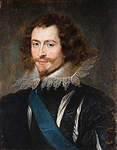
| George
Villiers
1st Duke of Buckingham
(1592-1628)[1]
Titles and Honours
1st Earl of Coventry, 1623[1]
1st Marquess of Buckingham, 1618[1]
1st Earl of Buckingham, 1617[1]
1st Viscount Villiers, 1616[1A]
1st Baron Whaddon of Whaddon, Bucks., 1616[1A]
Knight of the Garter, 1616[1]
Knighted, 1615[1]
Positions Held
Ambassador to the Hague, 1625[1]
Ambassador to Paris, 1625 and 1626[1]
Chancellor of Cambridge University, 1626-28†[1]
High Constable for the Coronation (of Charles I), 1626[1]
General of the Fleet and Army, 1625[1]
Commissioner of War, 1625[1]
Lord Warden of the Cinque Ports, 1624-28†[1]
Constable of Dover, 1624-28†[1]
Constable of Windsor Castle, 1624-28†[1]
Lord high admiral of England, 1619[1]
High Steward of Windsor, 1625[1]
High Steward of the Honour of Grafton, 1622[1]
Lord Lieutenant of Middlesex, 1622-28†[1]
Lord Lieutenant of Kent, 1620[1]
High Steward of Westminster, 1618-28†[1]
High Steward of Hampton Court, 1616[1]
Lord Lieutenant of Buckinghamshire, 1616-28†[1]
Joint Commissioner for the officer of Earl Marshal, 1616[1]
Master of the King's Bench[1]
Chief Justice in Eyre, 1616-19[1]
Keeper of Whaddon Park and Chase, 1616[1]
Master of the Horse, 1616-28†[1]
Gentleman of the Bedchamber, 1615 and 1625[1]
Cupbearer, 1614[1]
Biographical
In many respects, George Villiers was the lord and master of two English
kings, and during a few troubled years virtual sovereign of the empire.
He was educated in all the fashionable elegancies of the day. As a youth
he was preeminently graceful in person, in dress, in manner, in riding,
in dancing, in speech; and from his earliest years he had the position
of one of those arrogant favourites who win easy pardon for every caprice.
He was sent to France for two or three years, during which he devoted
himself to the arts and charms of 'la haute politesse', and returned to
England at the age of twenty-one. Presenting himself at court, he attracted
the notice of James I. A few days after his appearance, young Villiers
was made cup-bearer, and in a few weeks succeeded Somerset as chief favourite.
Offices and honours were showered upon him in profusion. He had learnt
that in dealing with a weak monarch, abounding arrogance is victory.[2]
Called to guide the grave affairs of a kingdom, through his influence
with James, Villiers treated events which determine the destinies of nations
as though they were intrigues to gratify personal pride and passion. The
famous journey of Prince Charles to Spain for the purpose of seeing his
intended bride, the Infanta, was planned by Villiers. During his absence
upon this journey he was created duke of Buckingham. In Spain, Buckingham's
gay and independent familiarity astonished the formal courtiers. The preliminaries
of the marriage were arranged, but afterwards broken of by James under
the influence of Buckingham, guided as much probably by personal hatred
to Olivarez as by motives of state policy.[2]
On the death of James, the duke's position at court was unchanged. As
before, the patronage alike in church and state was at his disposal, but
his general popularity was on the wane. He resented his increasing unpopularity
with a proud and indignant scorn, and to save him from impeachment, parliament
was hastily dissolved, although no adequate supplies had been granted
for the Spanish war. Buckingham was shortly after despatched to Paris
to conduct the princess Henrietta to England, as the bride of Charles
I. It is said that he ventured to address the French queen, not as an
ambassador, but a lover. Threatened with assassination if he dared to
repeat such insolence, he swore that he 'would see and speak with that
lady, in spite of the strength and power of France', and rumour went that
he did not break his wild oath. But not being able to obtain permission
to return to the French court, he openly espoused the cause of the Huguenots.
The duke himself went as admiral and general of the expedition against
France, which terminated in the disaster at the Isle of Rhè; and, subsequently,
made preparations for a new expedition in favour of Rochelle, then hotly
pressed by the royal forces.[2]
His popularity was now at its ebb. The commons impeached him as the one
source of national misfortunes. Sarcastic ballads were freely sung among
the people, threatening some terrible catastrophe Buckingham was willing
to stake all upon the expedition to relieve Rochelle. He spent threescore
thousand pounds of his own money upon the fleet; and declared that he
would be the first man who should set his foot upon the dyke before Rochelle,
'to die or do the work'. Soon afterwards, he was murdered by John Felton,
an embittered lieutenant. Engaged in battles against the Vandals in Africa,
the Persians and the Huns.[2]
Place of birth: Brokesby, Leicestershire[3]
Place of death: Portsmouth, Hampshire[3]
Place of burial: Westminster Abbey[1] |