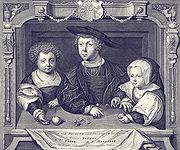
Princess
Margaret of England
(1489–1541)
Biographical
Regent of Scotland 1513–15 dep.
Margaret, Henry VII's eldest daughter, had her marriage to
James IV of Scotland arranged before she turned six. The negotiations
stretched over several years, aiming to secure an alliance that would
deter James's support of the pretender Perkin Warbeck. The marriage
was finally concluded on 8th August 1503. Henry VII offered a meagre
dowry, which led to disputes that worsened relations between the two
kingdoms, despite the accompanying treaty of perpetual peace. Margaret’s
life after her marriage was marked by constant political manoeuvring,
aligning at different times with factions in both Scotland and England,
often driven by financial interests. She was crowned in Edinburgh in
March 1504. After years of childlessness, she gave birth to several
children, though they all died young. James and Alexander followed,
though Alexander also died young. A dispute with her brother, Henry
VIII, over a legacy contributed to tensions between the two countries,
culminating in the Battle of Flodden, where James IV was killed on 9th
September 1513. James IV had named Margaret as the guardian of their
son, James V Scotland was divided between factions supporting alliances
with England and France, with Margaret leaning towards England. When
the Duke of Albany returned from France in 1514, conflict between the
factions nearly led to civil war. While proposals for her remarriage
were discussed, including offers from Louis XII of France and Emperor
Maximilian, Margaret secretly married Archibald Douglas, Earl of Angus,
on 6th August 1514. This union alienated much of the nobility, particularly
the earls of Arran and Home, and left her dependent on the house of
Douglas. As a result, she was removed from her position as regent in
favour of Albany. After a brief siege, Margaret was forced to surrender
her sons and was replaced by Albany. She fled to England in September
1515, where she had a daughter, also named Margaret, who later became
Countess of Lennox and the mother of Lord Darnley, James I’s grandfather.
In 1516, she visited her brother Henry VIII in London, while Angus returned
to Scotland, made peace with Albany, and regained his estates. Tensions
continued between the French and English factions, complicated by personal
rivalries between the Hamiltons and Douglases. Margaret, unhappy with
Angus over money matters, supported the Hamilton faction and sought
a divorce, which was backed by Albany but opposed by Henry VIII. By
1521, Margaret and Albany were accused of having an affair, with speculation
that their relationship was politically motivated. In 1524, after constant
border skirmishes between England and Scotland, Albany left for France.
Margaret’s efforts to have her son James V recognised as a sovereign
were successful in July 1524. In the following years, Margaret's personal
life was marked by her marriage to Henry Stewart, the second son of
Lord Avondale, whom she married after divorcing Angus in 1527. They
briefly became the dominant influence on James V, but when Margaret’s
efforts to arrange a meeting between James and Henry VIII in 1534 failed,
she was accused by her son of betraying him for money. In 1537, Margaret
sought another divorce from Stewart, but her efforts were blocked by
James. Two years later, she reconciled with Stewart, though their marriage
remained childless. Margaret continued to play a complex role in Scottish
and English politics until her death.
Place of birth: Westminster Palace
Place of first marriage: Holyrood House, Edinburgh
Place of second marriage: Kinnoull
Place of death: Methven Castle
Place of burial: St John's Abbey, Perth
Daughter
of King Henry VII of England (Tudor) and Elizabeth of York, she was
married firstly to King James IV of Scotland in 1503, with issue; secondly
to Archibald Douglas in 1514 (divorced 1528), with issue;
thirdly to Henry Stewart in 1527, with no issue.
|