
|
|
|
|||||||||
 |
||||||||||
| (201) | ||||||||||
| Henry
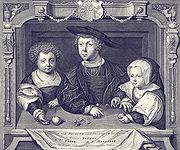
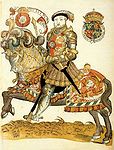
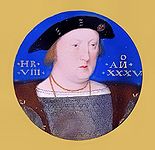
VIII King of England (1491–1547) Biographical King of England 1509–47† 'King of France', 1542–47† 'King of Ireland' 1542–47† Prince of Wales, 1503–09 Duke of York 1494–1509 Duke of Cornwall 1502–09 Earl of Chester 1503–09 Defender of the Faith 1521–47† [Papal] Knight of the Order of the Golden Fleece 1506 [HRE] Knight of the Bath 1494 [England] Knight of the Garter 1495 [England] Earl Marshal of England 1495 Lord Lieutenant of Ireland 1494 Constable of Dover Castle 1493 Lord Warden of the Cinque Ports 1493 Following the death of his brother Arthur in 1502, Henry became the heir to the throne and assumed the title of Prince of Wales. The next year, under pressure from his father, he was forced to marry his brother’s widow, Catherine of Aragon. Upon his father's death in 1509, Henry became king, and his accession was widely celebrated. The public was drawn to his personal charm and promising qualities, seeing him as one of the most accomplished princes in Europe at the time. He married Catherine, who was six years older than he was, a few months after becoming king. In 1512, Henry joined the Pope, King Ferdinand of Spain, and Emperor Maximilian in a military alliance against France, sending 10,000 men to invade Guienne. The mission ended in failure. In 1513, he personally invaded France and achieved victory at Guinegaste. The following year, peace was made with France, which involved the marriage of Henry’s sister, Mary, to King Louis XII of France. In 1513, James IV of Scotland, a French ally, crossed the border and was defeated at the Battle of Flodden by the English under the Earl of Surrey. At the start of Henry's reign, the key players vying for influence at court were Thomas Howard, Earl of Surrey, the Treasurer, and Fox, Bishop of Winchester, the Secretary. Fox introduced Henry to Thomas Wolsey, who quickly rose to power, replacing both men and becoming the king's favourite and primary minister. For about 15 years, Wolsey held almost total control over state affairs. In 1515, he was appointed Archbishop of York and later became a cardinal. During the rivalry between Emperor Charles V and King Francis I, both courted Henry’s friendship. Although Henry had the potential to leverage his position, he was more influenced by his impulses than by strategic planning, which limited his actual influence. Charles secured Wolsey’s support for his papal election bid, and in 1522, Henry declared war on France. The English army invaded France the following year, but relations between Wolsey and Charles soured after Pope Adrian’s election. By 1525, Wolsey had shifted allegiance and brokered a peace treaty with France. In 1526, Henry declared himself protector of the Holy League, formed by the Pope against Charles V. However, his reign’s foreign affairs soon became overshadowed by domestic events. In 1527, Henry, smitten by Anne Boleyn’s beauty and troubled by doubts over the legality of his marriage to Catherine, sought a divorce from the Pope. This request became a crucial issue in the Reformation, with Anne supporting Protestantism and Catherine remaining a devout Catholic. The Pope promised action but delayed the process for years. In 1529, Wolsey was disgraced, and Thomas Cranmer, a Protestant, was appointed Archbishop of Canterbury. As his quarrel with the Pope deepened, Henry’s support for the Reformers grew, increasing his power and wealth. In 1531, he declared himself Supreme Head of the Church of England. After the Convocations of York and Canterbury declared his marriage to Catherine invalid, Henry married Anne Boleyn in 1533 without papal consent. Catherine died in 1536. Under Henry’s direction, the English Church broke from Rome, leading to significant religious changes, including the dissolution of monasteries and the royal approval of a new translation of the Bible. In 1536, Anne Boleyn, having lost Henry’s favour, was executed on charges of infidelity, though some historians, such as Froude, offer a different perspective on her innocence. Shortly after Anne's execution, Henry married his next favourite, Jane Seymour. She died in 1537 after giving birth to their son, the future Edward VI. In 1540, Henry married Anne of Cleves, only to divorce her within six months, and later married Catherine Howard, who was executed in 1542 for infidelity. In 1543, Henry married his sixth and final wife, Catherine Parr. Despite his many excesses and cruelties, Henry remained popular with his subjects throughout his reign. He was described by historian David Hume as possessing great mental strength, courage, and determination, but his reign was also marked by some of the most damaging flaws of human nature. Place of birth: Greenwich Palace, Kent Place of first marriage: Greenwich Palace, Kent Place of second marriage: York Place, London Place of third marriage: Whitehall Palace, London Place of fourth marriage: Greenwich Palace, Kent Place of fifth marriage: Oatlands Palace, Surrey Place of sixth marriage: Hampton Court Palace Place of death: Whitehall Palace, London Place of burial: St George's Chapel, Windsor Son of King Henry VII of England (Tudor) and Elizabeth of York, he was married firstly to Catherine of Aragon in 1509 (annulled 1533) with issue: • an unnamed daughter, d. at birth 1510 • Henry (see) • an unnamed son (see) • an unnamed son (see) • Mary I (see) • an unnamed daughter, d. at birth 1518 Henry was married secondly in 1533 (divorced 1536) to Anne Boleyn with issue: • Elizabeth I (see) Henry was married thirdly in 1536 to Jane Seymour 1536 with issue: • an unnamed child (see) • an unnamed son (see) • Edward VI (see) Henry was married fourthly in 1540 (annulled 1540) to Anne of Cleves with no issue. Henry was married fifthly in 1540 to Katherine Howard with no issue. Henry was married sixthly to Katherine Parr in 1543 with no issue. Henry had illegitimate issue by Elizabeth Blount: • Henry Fitzroy (see) Henry possibly had illegitimate issue by Jane Dingeley: • Audrey (see) |
||||||||||
| |
||||||||||








 |
||||||||||
| |
||||||||||
 |
||||||||||


