
|
|
|
|||||||||
 |
||||||||||
| Carle Vernet (1758–1836) | ||||||||||
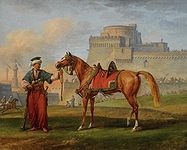
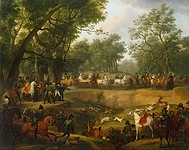
| Antoine Charles Horace Vernet, better known as Carle Vernet, was born in Bordeaux in 1758, the son of the renowned painter Claude Joseph Vernet. From an early age, he exhibited a natural flair for drawing and trained under both his father and the painter Lepicier. By the age of twenty-one, he had won second prize at the Academy of Painting, and three years later, he was awarded the Grand Prix de Rome. While in Italy, Vernet led a somewhat rebellious lifestyle and briefly considered becoming a monk, which prompted his father to call him back to France. He was admitted to the Academy in 1788. Vernet painted with a lively, naturalistic style that blended precise draughtsmanship with vigorous movement, specialising in military scenes, sporting subjects, and contemporary life, with a particular focus on horses and elegant figures depicted in clear, vibrant colours. His work became focused primarily on equestrian subjects, and his friendships with the Marquis de Villette and the Comte de Lauragnais placed him at the centre of the 'Anglomania' trend, which popularised horse-racing in France. Although initially sympathetic to the Revolution, he was wounded while fleeing the events of 10 August 1792, and the execution of his sister left him deeply unsettled until the calmer period of the Directory. Shifting away from classical themes, he began focusing on military subjects. In 1810, he was elected to the Institute. Under the Restoration, Vernet produced works on hunting, racing, landscapes, portraits, and lighter themes. He also created a significant number of lithographs and drawings, notably those documenting the Italian campaigns, which were engraved by Duplessis-Bertaux. He died in Paris. | ||||||||||
| |
||||||||||

 |
||||||||||
|
|
||||||||||
| |
||||||||||
  |
||||||||||


 Art
Art