|
|
|
|
|

|
|
|
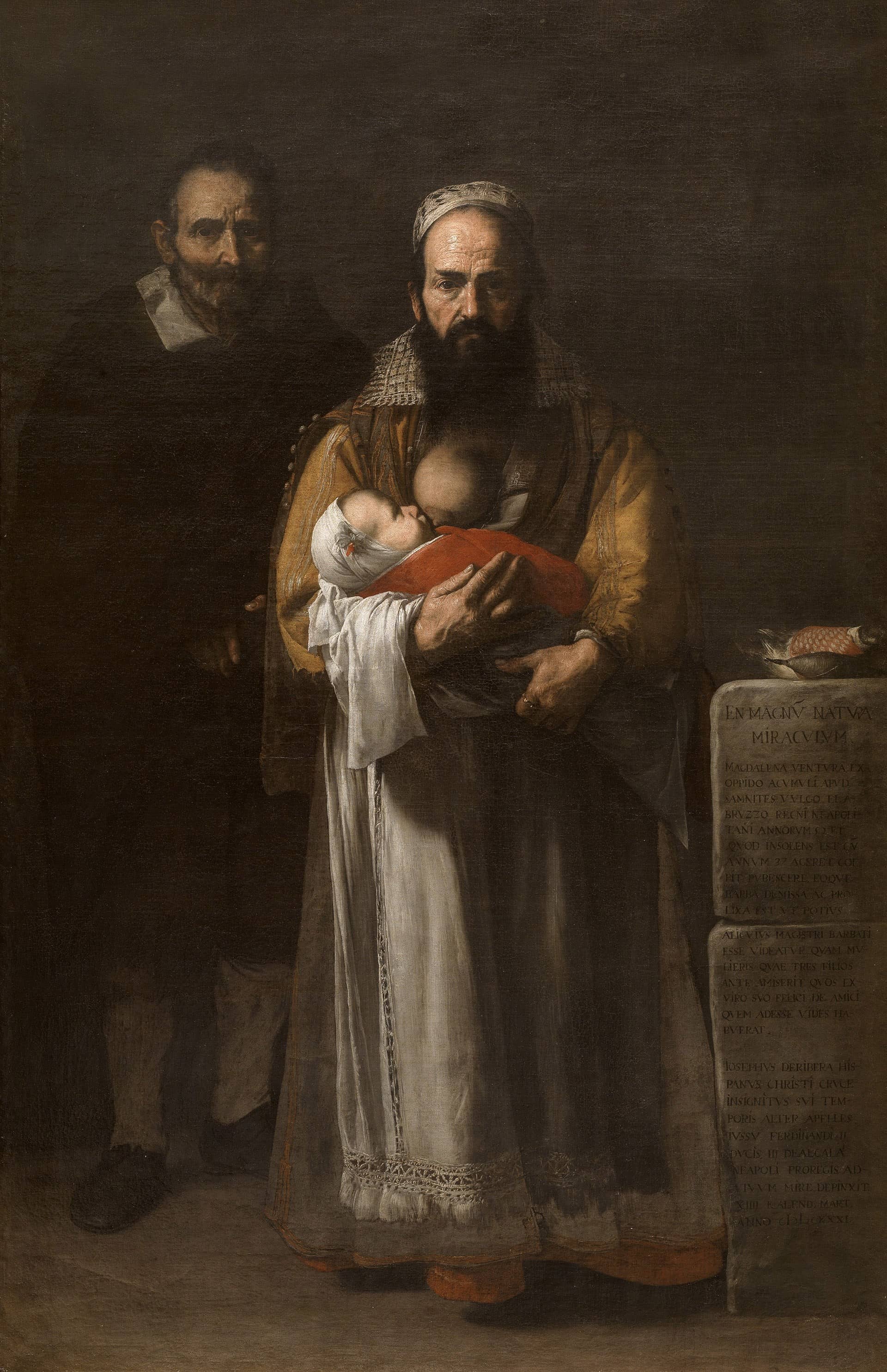
The Bearded Lady of Abruzzo
Oil on canvas, 193.8 x 125.8 cm, by Jusepe de Ribera, 1631
Fundación Casa Ducal de Medinaceli, on loan at the Museo del Prado,
Madrid
|
Also known as Magdalena
Ventura with her Husband and Son, this tenebrist work by
Spagnoletto transforms the phenomenon of female virilisation into a
powerful and emotionally charged image. It portrays Magdalena, a
woman with a rare condition that caused her to grow a beard,
alongside her husband and son. Ribera’s use of dramatic chiaroscuro,
precise brushwork, and symbolic still-life elements conveys profound
psychological depth and tension, while also offering a portrayal of
dignity and respect for the subject. In contrast to other works of
the period that often sensationalised or marginalised such
individuals, Ribera’s realistic approach emphasises the humanity of
the figure. The painting blends realism with an air of enigmatic
suggestion, engaging both scientific curiosity and artistic skill.
The Latin text carved on stone reads
|
:
In great nature / miracle / Magdalena Ventura from / the town
of Acumuli among / the Samnites, commonly known as Abruzzo of the
Kingdom of Naples, aged 52 years, and / which is unusual, at the age
of 37 she began to grow a beard and / with a long and thick beard,
she appears more like / a bearded master than a woman who / had lost
three children before / whom you see here with her happy husband /
of a friend. Joseph de Ribera, a Spaniard, marked by the cross of
Christ / distinguished himself. Another Apelles of his time / by the
order of Ferdinand II / Duke III of Alcalá / Naples, the viceroy,
painted her marvellously alive / on the 14th of March / in the year
1631.
|
|
| |