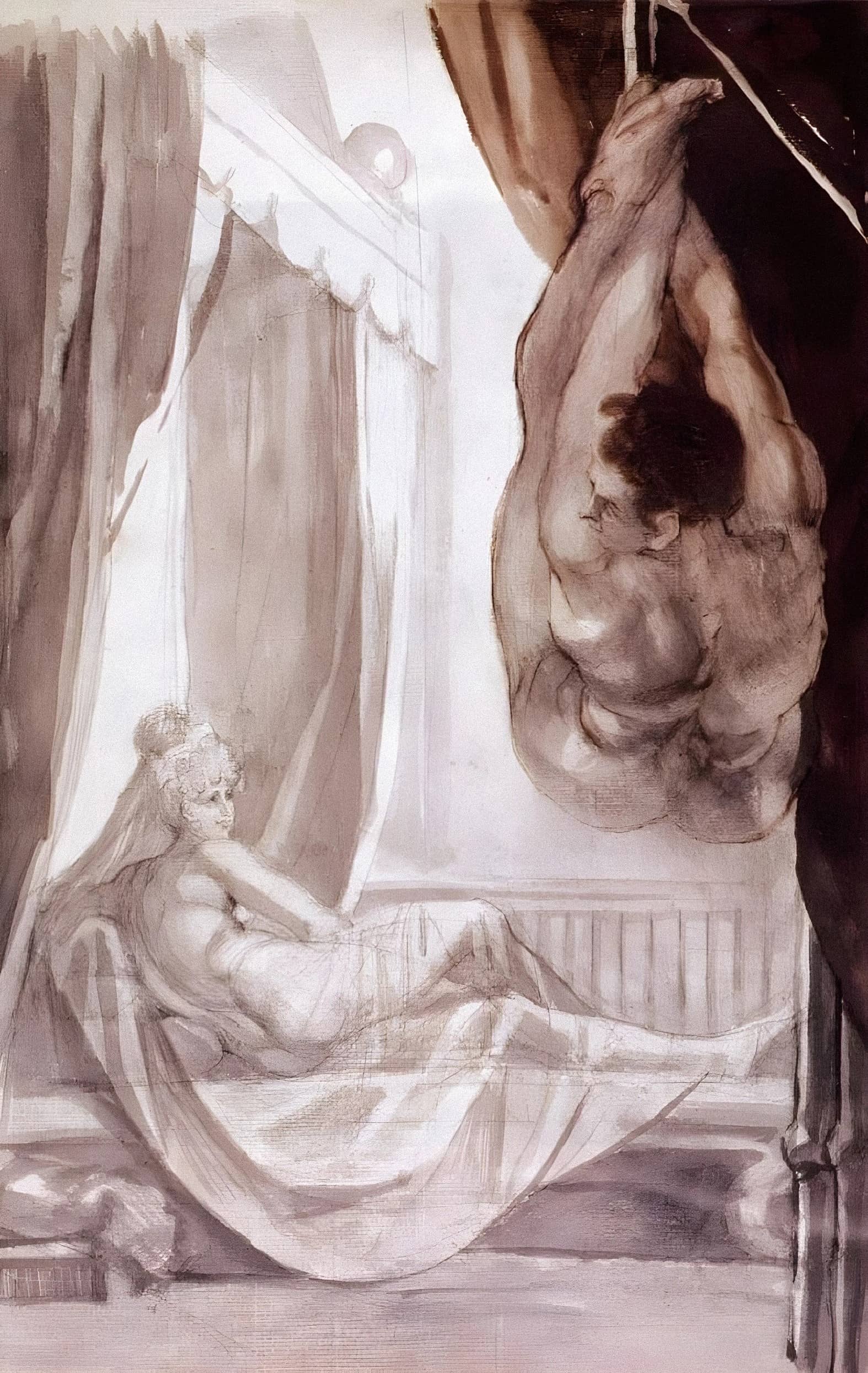
A moment drawn from the
legend of Brunhilde and Gunther from the Nibelungenlied (The
Song of the Nibelungs), a Middle High German epic poem from
around the 13th century in Austria or Bavaria. The story was later
adapted and popularised through Richard Wagner's opera cycle Der
Ring des Nibelungen, especially in his opera Götterdämmerung.
Brunhilde is a powerful queen who will only marry a man who can
defeat her in physical trials. Gunther, wanting to marry her,
enlists the help of Siegfried, who uses a magical cloak to become
invisible and defeat her in Gunther’s place. After being tricked
into marriage, Brunhilde later realises the deception. In some
tellings—particularly later adaptations—this betrayal leads to a
dramatic reversal in which she overpowers or humiliates Gunther. As
interpreted here by Fuseli, she has tied and suspended Gunther from
the ceiling. The scene flips traditional gender roles and reflects
themes of strength, deceit, and domination found in the
Nibelungenlied and later Wagnerian interpretations. Fuseli,
known for his fascination with myth, erotic tension, and
psychological intensity, draws on this element of humiliation and
revenge to present Brunhilde calmly observing while Gunther’s
muscular form hangs contorted above, adding an element of theatrical
absurdity. His figures are modelled with bold contrasts, and the
brushwork ranges from controlled, muscular outlines to softer, more
fluid washes in the background and drapery. Fuseli’s distinctive
style is evident in the exaggerated anatomy, dramatic lighting, and
emotionally charged atmosphere. The image feels more dreamlike than
realistic, in keeping with his usual approach to mythological
themes.