
|
|
|
|||||||||
 |
||||||||||
 |
||||||||||
 |
||||||||||
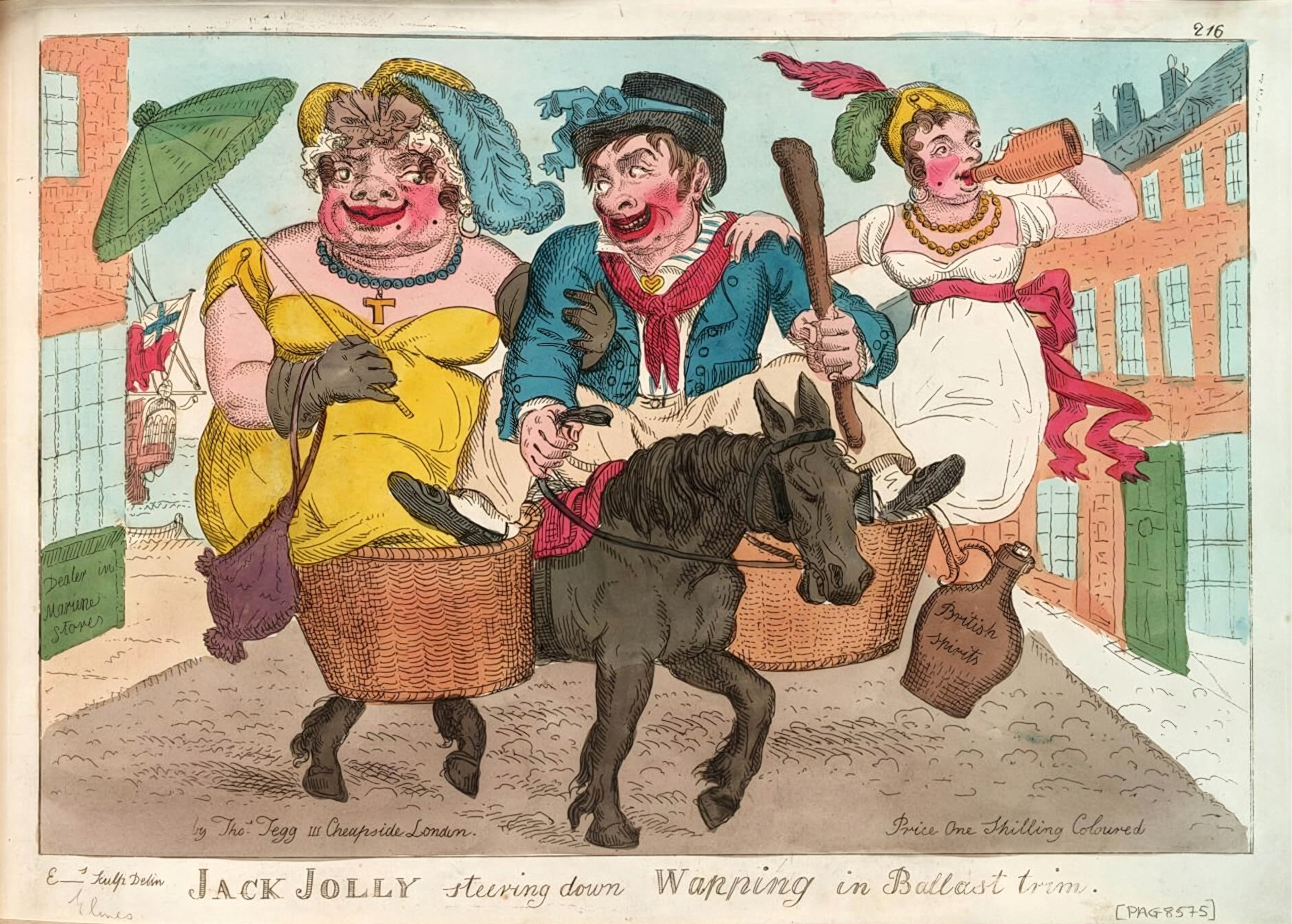
Jack Jolly steering down Wapping in Ballast trim Coloured etching, 25.3 x 36.3 cm, by William Elmes, 1813 National Maritime Museum, Greenwich |
||||||||||
| A satirical etching that caricatures the licentious behaviour of sailors returning to port, particularly in the maritime district of Wapping in East London, which was infamous in the early 19th century for its taverns, brothels, and maritime commerce. At the centre is Jack Jolly, a sailor perched atop a visibly strained donkey, which bears two oversized women in panniers slung over its sides. The composition is exaggerated and chaotic, designed to mock both the sailor’s bravado and the unruly nature of his companions. The sailor leers toward the woman on his right, who is heavily made-up and exaggeratedly corpulent, wears a yellow dress and a cross necklace, and holds a parasol—an ironic nod to genteel fashion while exaggerating sexual indulgence and excess. The woman on his left, dressed in white with a red sash, clutches a bottle; her flushed cheeks and animated posture suggest drunkenness. Jack Jolly himself grins with satisfaction, seemingly unaware of the absurdity of the scene he is orchestrating. The title’s phrase 'in Ballast Trim' borrows from nautical terminology, referring to a ship’s weight distribution when not carrying cargo. Elmes repurposes it here as a crude joke: Jack Jolly’s 'ballast' consists of his two corpulent companions, whose bulk and behaviour destabilise both his literal and moral balance. Though less polished than the work of Gillray or Rowlandson, Elmes’ etching fits squarely within the Regency tradition of caricature, using grotesque distortion and theatrical composition to critique the social dynamics of the time. |
||||||||||
 |
||||||||||


