
|
|
|
|||||||||
 |
||||||||||
| Paul Cezanne (1839–1906) | ||||||||||
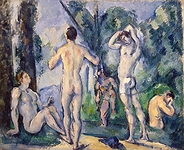
| Born at Aix-en-Provence, Cezanne was a contemporary and friend of Zola, with whom he shared an interest in literature. In 1862, he was persuaded by Zola to transfer to Paris, and there he studied at the Academic Suisse. In Paris, he met the circle of painters centred on Manet, but found himself not truly in accord with them, and thereafter worked mainly at Aix and l'Estaque, with occasional visits to Paris, where he exhibited at the first and third Impressionist exhibitions in 1874 and 1877. He was influenced by Pissarro, with whom he worked at Auvers and Pontoise between 1872 and 1873. He abandoned his former sombre expressionism for the study of nature, as in the famous Maison du Pendu of this period in the Louvre, and began to use his characteristic glowing colours. In his later period, after 1886, when he became financially independent of his father, he emphasised the underlying forms of nature—'the cylinder, the sphere, the cone'—by constructing his picture from a rhythmic series of coloured planes, painting not light but plastic form, and thus becoming the forerunner of Cubism. His wife, Hortense Fiquet, is reputed to have had the occasional task of retrieving completed canvases, abandoned by her husband wherever he happened to have been working on them—for his passion was the actual painting on them, not the possession. In 1886, his friendship with Zola was ended by the publication of the latter’s novel, L'Œuvre, in which the central figure, an unsuccessful and unbalanced Impressionist painter, is in many respects identifiable as Cezanne. Cezanne, who himself described his aim as being 'to make Impressionism something solid and durable like the art of the old masters,' obtained recognition only in the last years of his life, and two exhibitions of his works were held by Vollard, in 1895 and 1899. He died at Aix-en-Provence. | ||||||||||
| |
||||||||||


 |
||||||||||
|
|
||||||||||
| |
||||||||||
  |
||||||||||


 Art
Art