
|
|
|
|||||||||
 |
||||||||||
| Le Voyage de Charles Magius | ||||||||||
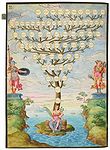
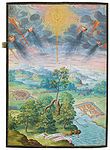
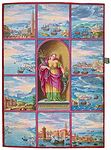
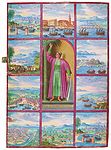
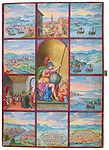
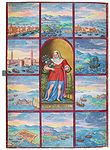
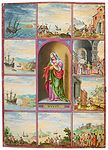
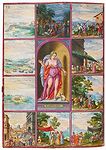
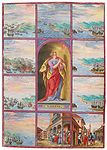
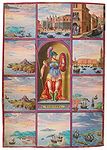
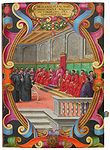
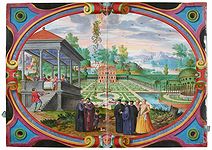
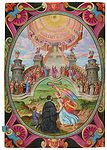
| This remarkable work, created in 1578, chronicles the travels and adventures of Charles Magius (Carlo Maggio), a Venetian noble. Comprising just eighteen pages, it features a series of finely executed miniature paintings on vellum, some attributed to the hand of Paul Veronese. Each page is effectively a collection of many chapters, with a central image surrounded by ten smaller ones, accompanied by inscriptions, allegories, and references that narrate the romantic episodes in the life of this Venetian aristocrat. Yet this volume should not be admired solely as a beautiful work of art, for it carries a deeper significance, bound to the circumstances that prompted its creation. Magius, who is both author and protagonist, had long been subject to slander. Seeking to expose the truth to his accusers, he endeavoured to convey his suffering and adventures in a manner more vivid than words alone could capture. Rather than penning a lengthy and tedious account of his life to defend his honour, he conceived a new form of pictorial biography. He carefully outlined the extraordinary situations in which fortune had placed him, and the artists, in turn, enriched the narrative with their depictions, striving to bring to life the events he described, offering a dynamic portrayal that writing could not achieve. This innovative work may be seen as a prototype for future accounts, in which individuals might immortalise their histories through art, revealing the forms and colours of their exceptional lives with the brush rather than the pen. It was during the Ottoman attack on Cyprus in about 1571 that Magius was commissioned by the Venetian Republic to assess and repair the island's fortifications. Subsequently, he was sent to the Pope to negotiate an alliance, before returning to the Senate to report on his mission. Appointed to command Venetian forces, Magius led a determined defence of Cyprus, but despite his efforts, the island fell. Captured by the Turks at Famagusta, he was enslaved. Eventually, his age and deteriorating health prompted his master to sell him to Christian merchants. After years of absence from Venice, he returned, surprising and humiliating those who had continually slandered him, while his noble family remained silent, having had no contact with their lost and captive relative. Magius returned not only to restore his honour and regain the favour of the Senate, but also to be reunited with his family. In a symbolic gesture, he introduced a new branch to his lineage: a young boy of seven, the child of his hardships, who had known neither affection nor the comfort of family life, but was now embraced by his loved ones. This unique volume is housed in the Bibliothèque nationale de France. | ||||||||||
| |
||||||||||

 
 |
||||||||||
|
|
||||||||||
| |
||||||||||
 |
||||||||||


