
|
|
|
|||||||||
 |
||||||||||
| Salamanca Cathedrals | ||||||||||
|
Salamanca has two cathedrals
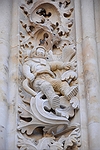
that are joined together: the Old Cathedral, and the New Cathedral. The Old Cathedral is mainly Romanesque, with later Gothic additions in decoration and structure. Founded by Bishop Jerome of Périgord under Count Raymond of Burgundy, it began construction around 1102, possibly by French architects Casandro Romano and Florín de Pituenga. Early on, Moorish prisoners, including up to 500 carpenters and masons, were put to work on the building. Though unfinished at Jerome's death, the crossing and Capilla Mayor were consecrated by the mid-century. The cathedral’s layout follows that of the original basilica, with a nave and side aisles, a crossing extended south, and a semicircular apsidal chapel. Notable features include a dome with four circular pinnacles, two cloisters (built between 1170 and 1178), and the Talavera Chapel, built in 1510 for the Mozarabic Rite. The New Cathedral's southern wall replaces the Old Cathedral's northern wall, and a flight of steps leads from the lower level of the Old Cathedral to the new one. The western front was heavily altered, with the removal of the original towers and the addition of a narrow passage through the later masonry. The New Cathedral, dedicated to the Assumption of the Virgin, was designed between 1508 and 1510 by Alonso Rodríguez and Annequín de Egas, with Juan Gil de Hontañón's plan chosen in 1512. Construction began on 12 May 1513, and the cathedral is mainly Spanish Gothic with Renaissance elements. The first service was held in 1560, and it was consecrated in 1713, completed in 1734. The layout, similar to Seville’s cathedral, is a vast rectangle with ten bays, measuring 378 feet long and 181 feet wide. It includes a nave, double side aisles, square chapels, and the Capilla Mayor at the eighth bay, with a lantern above the sixth. The Patio Chico separates the sacristy from the Old Cathedral, and the junction of the two is hidden by the large tower. The northern front offers an unobstructed view, while the western front has a triple doorway. Sculptures by Juan de Juni and Gaspar Becerra adorn the west front, and the tabernacle (c. 1800) was designed by Manuel Martín Rodríguez. The cathedral was damaged in the 1755 Lisbon earthquake but repaired. In 1992, stonemason Miguel Romero added a famous astronaut carving to the northern façade as part of a restoration. A gargoyle holding an ice cream cone honours Café Novelty, the oldest coffee house in Salamanca. The astronaut carving was vandalised in 2010, but later restored. |
||||||||||
| |
||||||||||



  |
||||||||||
|
|
||||||||||
| |
||||||||||
  |
||||||||||


