
(M14)
Amazon
Ads |


(fl c. 3700 BC?)
Biographical
Lamech appears in each of the two antediluvian genealogies. In the first, he is a descendant of Cain, and through his sons the author of primitive civilisation; in the latter he is the father of Noah. But it is now generally held that these two genealogies are variant adaptations of the Babylonian list of primitive kings. It is doubtful whether Lamech is to be identified with the name of any one of these kings; he may have been introduced into the genealogy from another tradition. He is recorded to have taken two wives, Adah and Zillah; and there appears no reason why the fact should have been mentioned, unless to point him out as the author of the practice of polygamy.
In the older narrative in Genesis iv, Lamech’s family are the originators of various advances in civilisation. He has three sons, Jabal, Jubal, and Tubal-Cain, authors of various arts. The assonance of these names is probably intentional, and comparable with the brothers Hasan and Hosein of early Muhommedan history. Lamech has also a daughter, Naamah. The narrative of his family clearly intends to account for the origin of the various arts as they existed in the narrator’s time; it is not likely that he thought of these discoveries as separated from his own age by a universal flood; nor does the tone of the narrative suggest that the primitive tradition thought of these pioneers of civilisation as members of an accursed family. Probably the passage was originally independent of the document which told of Cain and Abel and of the Flood.
The most remarkable circumstance in connection with Lamech is the poetical address which he is very abruptly introduced as making to his wives. This is not only remarkable in itself, but is the first and most ancient piece of poetry in the Hebrew Scriptures; and, indeed, the only example of Antediluvian
poetry extant:
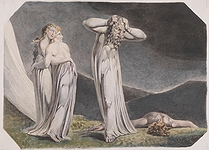
Adah and Zillah, hear my voice!
Wives of Lamech, receive my speech!
If I slew a man to my wounding,
And a young man — to my hurt:
If Cain was avenged seven times.
Then Lamech — seventy times seven.
a conjecture. So far as we can make it out. it would seem to be, an apology for committing homicide, in his own defence, upon some man who had violently assaulted him, and, as it would seem, struck and wounded him; and he opposes a homicide of this nature to the willful and inexcusable fratricide of Cain. Under this view, Lamech would appear to have intended to comfort his wives by the assurance that he was really exposed to no danger from this act. and that any attempt upon his life on the part of the friends of the deceased
would not fail to bring down upon them the severest vengeance. This is the second death we read of in the Bible, and both first and second were with violence.
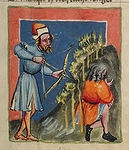
Hebrew tradition tells us that the man killed by Lamech was in fact Cain himself, despite the large generational gap. The non-canonical Book of Jasher recounts that Lamech became blind in his old age, and he was led about by the boy Tubal-cain. Tubal-cain saw Cain in the distance, and supposing from the horn on his forehead that he was a beast, he said to his father, 'Span thy brow and shoot!' Then the old man discharged his arrow, and Cain fell dead. But when he ascertained that he had slain his great ancestor, he smote his hands together, and in so doing, by accident struck his son and killed him. Therefore his wives were wroth and would have no communication with him. But he appeased them with the words recorded in Genesis.
© 2024 The Universal Compendium