Amazon
Ads |


Aello
Parentage: Thaumas and Electra (1)
Alternative parentage: Pontus (or Poseidon) and Terra; Typhon; Phineus
Other names: Aellopos, Nicothoe
Biographical
The Harpies (Harpyiae), that is, 'the swift robbers',
are, in the Homeric poems, nothing but personified storm winds. Homer
mentions only one by name, Podarge, who was married to Zephyrus, and gave
birth to the two horses of Achilles, Xanthus and Balius. When a person
suddenly disappeared from the earth, it was said that he had been carried
off by the Harpies; thus, they carried off the daughters of king Pandareus,
and gave them as servants to the Erinnyes. According to Hesiod, the Harpies
were the daughters of Thaumas by the Oceanid Electra, fair-locked and
winged maidens, who surpassed winds and birds in the rapidity of their
flight. Their names in Hesiod are Aello and Ocypete. But even as early
as the time of Aeschylus, they are described as ugly creatures with wings,
and later writers carry their notions of the Harpies so far as to represent
them as most disgusting monsters. They were sent by the gods as a punishment
to harass the blind Phineus, and whenever a meal was placed before him,
they darted down from the air and carried it off; later writers add, that
they either devoured the food themselves, or that they dirtied it by dropping
upon it some stinking substance, so as to render it unfit to be eaten.
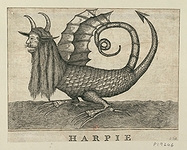
They are further described in these later accounts as birds with the heads
of maidens, with long claws on their hands, and with faces pale with hunger.
Their parentage likewise differs in the different traditions. Their number
is either two, as in Hesiod and Apollodorus, or three; but their names
are not the same in all writers, and, besides those already mentioned,
we find Aellopos, Nicothoe, Ocythoe, Ocypode, Celaeno, Acholoe. Their
place of abode is either the islands called Strophades, a place at the
entrance of Orcus, or a cave in Crete. The most celebrated story in which
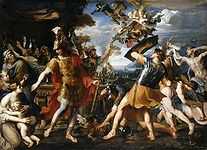
the Harpies play a part is that of Phineus, at whose residence the Argonauts
arrived while he was plagued by the monsters. He promised to instruct
them respecting the course they had to take, if they would deliver him
from the Harpies. When the food for Phineus was laid out on a table, the
Harpies immediately came, and were attacked by the Boreades, Zetes and
Calais, who were among the Argonauts, and provided with Harpies were to
perish by the hands of the Boreades, but the latter were to die if they
could not overtake the Harpies. The latter fled, but one fell into the
river Tigris, which was hence called Harpys, and the other reached the
Echinades, and as she never returned, the islands were called Strophades.
But being worn out with fatigue, she fell down simultaneously with her
pursuer; and, as they promised no further to molest Phineus, the two Harpies
were not deprived of their lives. According to others, the Boreades were
on the point of killing the Harpies, when Iris or Hermes appeared, and
commanded the conquerors to set them free, or both the Harpies as well
as the Boreades died. In the famous Harpy monument recently brought from
Lycia to this country, the Harpies are represented in the act of carrying
off the daughters of Pandareus.

Families | Lands | Abbreviations and Symbols