
|
|
|
|||||||||
 |
||||||||||
| (M10-V) | ||||||||||
| Pan
(1)
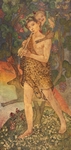
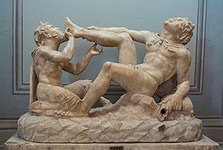
Other names: The Lycaean, Pan Lyterius, Pan Maenalius, Pan Nomius Biographical God of flocks, shepherds, pastures, Pan was said to have been fully developed from birth and already possessed the appearance he always retained: horns, a beard, a flattened nose, a tail, goat’s feet, and a body covered in hair. After his birth on Mount Lycaeon, his mother fled in fear at the sight of him, but Hermes carried him to Mount Olympus, where all the gods delighted in him, especially Dionysus. He was raised by nymphs. The chief centre of his worship was Arcadia, from which his cult later spread to other parts of Greece, while in Athens his worship was not introduced until the time of the Battle of Marathon. In Arcadia, Pan was regarded as the god of forests, pastures, flocks, and shepherds, dwelling in caves and wandering across mountains, rocky places, and valleys, either hunting or leading the dances of the nymphs. As protector of both wild and domesticated animals, he was believed to increase and guard the flocks, while hunters also depended upon him for success, though he could just as easily deny it. Arcadian hunters were said to whip his statue if their hunt failed. During the heat of midday he slept, and he became angry when disturbed. Bees were also under his protection, as were coastal waters used by fishermen. Closely connected with pastoral life, Pan loved music and was believed to have invented the syrinx, or shepherd’s pipe, which he played with great skill and taught to others, including Daphnis. It was recounted that when he pursued the nymph Syrinx, Gaea turned her into reeds, and Pan made a reed pipe from seven of them. Ancient tradition also claimed that he admired the poet Pindar and sang and danced to his lyric poetry, for which Pindar dedicated a sanctuary to him outside his house. Like many woodland gods, Pan was feared by travellers, to whom he sometimes appeared suddenly and caused terror. When Pheidippides travelled to Sparta seeking aid against the Persians, Pan was said to have appeared to him and promised to terrify the enemy if the Athenians worshipped him. He was also believed to possess an overwhelming voice, with which he frightened the Titans during their war against the gods. This association with noise and wild disorder connected him with Cybele and Dionysus, whose companion he was often considered to be. Pan was also thought to possess prophetic powers and was even said to have instructed Apollo in prophecy. Pine trees were sacred to him because the nymph Pitys, whom he loved, had been transformed into one. Sacrifices offered to Pan included cows, rams, lambs, and milk, and offerings were often made jointly to him, Dionysus, and the nymphs. In other events, Pan was said to have given Artemis hunting dogs and hounds, and to have helped Hermes restore the sinews of Zeus after they were chopped off by Typhon during the War of the Titans. The many epithets applied to him by ancient poets referred either to his unusual appearance or to the places where he was worshipped. Sanctuaries and temples dedicated to Pan were especially numerous in Arcadia, including those at Heraea, on the Nomian hill near Lycosura, on Mount Parthenius, near Acacesium, where a perpetual sacred fire burned in his temple and an ancient oracle stood, where the nymph Erato served as priestess, and near the spring of Eresinus between Argos and Tegea, among many other places. He was identified by the Romans with Faunus and Inuus. Sources differ on his parentage and include the following: Hermes and Dryope, Hermes and a nymph, Hermes and Callisto, Hermes and Oeneis, Hermes and Thymbris, Odysseus and Penelope, Hermes and Penelope, Penelope and all of her suitors, Aether and Oeneis, Aether and a Nereid, Uranus and Ge, Aegipan, Zeus and Hybris, Asia. He is said to have been married to Aega. By Echo or Peitho he had issue: • Iambe • Iynx By Eupheme, he had: • Crotus By Simaethis, he had • Acis By a nymph or Gaea, he had • Silenus By Aphrodite, he had: • Priapus |
||||||||||
| |
||||||||||
  |
||||||||||
| |
||||||||||
 |
||||||||||


