|
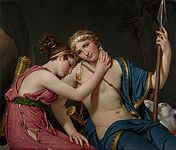
Telemachus
Still an infant at the time when his father went to Troy, and in his absence
of nearly twenty years he grew up to manhood. After the gods in council had
determined that Odysseus should return home from the island of Ogygia,
Athena, assuming the appearance of Mentes, king of the Taphians, went to
Ithaca, and advised Telemachus to eject the troublesome suitors of his
mother from his house, and to go to Pylos and Sparta, to gather information
concerning his father. Telemachus followed the advice, but the suitors
refused to quit his house; and Athena, in the form of Mentes, accompanied
Telemachus to Pylos.[15B]
There they were hospitably received by Nestor, who also sent his own son to
conduct Telemachus to Sparta. Menelaus again kindly received him, and
communicated to him the prophecy of Proteus concerning Odysseus. From Sparta
Telemachus returned home; and on his arrival there, he found his father,
with the swineherd Eumaeus. But as Athena had metamorphosed him into a
beggar, Telemachus did not recognise his father until the latter disclosed
to him who he was. Father and son now agreed to punish the suitors; and when
they were slain or dispersed, Telemachus accompanied his father to the aged
Laertes. In the Post-Homeric traditions, we read that Palamedes, when
endeavouring to persuade Odysseus to join the Greeks against Troy, and the
latter feigned idiotcy, placed the infant Telemachus before the plough with
which Odysseus was ploughing.[15B]
According to one account, he married Cassiphone, daughter of Circe, but in a
quarrel with his mother-in-law he slew her, for which in his turn he was
killed by Cassiphone. He is also said to have had a daughter called Roma,
who married Aeneas. One account states that Odysseus, in consequence of a
prophecy that his son was dangerous to him, sent him away from Ithaca.[15B]
Servius makes Telemachus the founder of the town of Clusium in Etruria.[15B] |