|
|
|
|||||||||
 |
||||||||||
| (M10-D) | ||||||||||
| Theseus
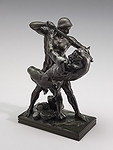
King of Athens Biographical Theseus, the legendary hero of Attica, is one of the most complex figures in Greek mythology. His story, shaped and reshaped over time, was heavily influenced by later Athenian writers who portrayed him as a historical figure and founder of Athenian identity. This approach, notably taken by Plutarch, sought to minimise the mythical and emphasise his political and cultural significance. When he came of age, Theseus, following his mother’s instructions, took up the sword and sandals that Aegeus had left behind and set out for Athens. Inspired by Heracles, he chose the perilous land route, defeating a series of bandits and monsters. Upon arrival in Athens, he was purified and soon recognised by Medea, who tried to poison him. However, Theseus was recognised by Aegeus, thanks to the sword he carried, who then acknowledged him as his son and declared him his successor. This angered the sons of Pallas, who attempted a coup but were defeated. Theseus then captured the Marathonian Bull, the same beast that had caused the death of Minos’s son, Androgeos. When Athens was once again forced to send a tribute of seven youths and seven maidens to Crete, Theseus volunteered, intending to slay the Minotaur. In Crete, he gained the love of Ariadne, who gave him a sword and a ball of thread to navigate the labyrinth. He killed the Minotaur and escaped, taking Ariadne with him. Most versions of the story report that Theseus either lost or abandoned Ariadne on the island of Naxos. As he sailed home, he forgot to raise the white sail that would signal his success. Seeing the black sail, Aegeus believed his son was dead and leapt to his death. A ship believed to be the very one Theseus sailed on was preserved into the historical period and used in annual sacred voyages to Delos. Though Homer mentions Theseus abducting Ariadne, he makes no reference to the Minotaur — suggesting that part of the myth was a later development, likely elaborated to elevate Theseus as a national hero. He also participated in many other legendary exploits: the Argonauts' voyage, the Calydonian Boar Hunt, and the campaign to recover the fallen at Thebes. Theseus formed a close bond with Pirithous, helping him fight the Centaurs and even attempting to kidnap Persephone from the Underworld — a venture that failed, resulting in Pirithous’s death and Theseus’s imprisonment until rescued by Heracles. He also abducted Helen as a child and placed her in Attica under guard, which led to a Spartan invasion and her eventual retrieval. Castor and Pollux then invaded Attica and reclaimed Helen after being informed of her whereabouts by Academus. Menestheus incited the people against Theseus, and when he returned, he was unable to reclaim his authority. He withdrew to Scyros, where he was treacherously killed by Lycomedes. Later, during the Persian Wars, Athenians believed Theseus appeared as a ghost to aid them at Marathon. In 469 BCE, Cimon claimed to have discovered his remains on Scyros, which were returned to Athens and interred in a temple dedicated to him — ruins of which still stand. Theseus was honoured with several festivals, including the Theseia, the Oschophoria, and the Pyanepsia. While his myth is full of fantastical elements, Athenians credited him with major political reforms: uniting the scattered communities of Attica into a single political entity centred on Athens, thereby establishing it as a major city-state. This unification was celebrated through the Synoecia festival, and the Panathenaea was revived in his honour. There can be little doubt that Theseus is a wholly legendary figure, as mythical as his supposed contemporary Heracles. His myth reflects the political and cultural aspirations of Athens. The theory that he represents an Ionian migration into Attica — supported by his connections to Poseidon and Troezen, and his path through the Isthmus — suggests that his legend may symbolise real historical transitions and cultural integrations, even if he himself was not a real person. Son of Aegeus, King of Athens, and Aethra; alternatively, the son of Poseidon and Aethra. He had issue by Ariadne; married Antiope, and had issue by her; after her death, he married Phaedra. |
||||||||||
| |
||||||||||
| |
||||||||||
 |
||||||||||