|
Attis (1)
Other names: Atys, Attys, Attes, Attis, Attin[15]
A beautiful shepherd of the Phrygian town, Celaenae. His story is related in
different ways.[15]
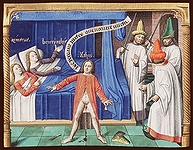
According to Ovid, Cybele loved the beautiful shepherd, and made him her own
priest on condition that he should preserve his chastity inviolate. Atys
broke the covenant with a nymph, the daughter of the river-god Sangarius,
and was thrown by the goddess into a state of madness, in which he unmanned
himself. When in consequence he wanted to put an end to his life, Cybele
changed him into a fir-tree, which henceforth became sacred to her, and she
commanded that, in future, her priests should be eunuchs.[15]
Another story relates, that Atys, the priest of Cybele, fled into a forest
to escape the voluptuous embraces of a Phrygian king, but that he was
overtaken, and in the ensuing struggle unmanned his pursuer. The dying king
avenged himself by inflicting the same calamity upon Atys. Atys was found by
the priests of Cybele under a fir-tree, at the moment he was expiring. They
carried him into the temple of the goddess, and endeavoured to restore him
to life, but in vain. Cybele ordained that the death of Atys should be
bewailed every year in solemn lamentations, and that henceforth her priests
should be eunuchs.[15]
A third account says that Cybele was exposed by her father, the Phrygian
king Maeon, was fed by panthers, and brought up by shepherdesses, and that
she afterwards secretly married Atys, who was subsequently called Papas. At
this moment, Cybele was recognised and kindly received by her parents; but
when her connection with Atys became known to them, Maeon ordered Atys, and
the shepherdesses among whom she had lived, to be put to death. Cybele,
maddened with grief at this act of her father, traversed the country amid
loud lamentations and the sound of cymbals. Phrygia was now visited by an
epidemic and scarcity. The oracle commanded that Atys should be buried, and
divine honours paid to Cybele; but as the body of the youth was already in a
state of decomposition, the funeral honours were paid to an image of him,
which was made as a substitute.[15]
According to a fourth story related by Pausanias, Atys was a son of the
Phrygian king Calaus, and by nature incapable of propagating his race. When
he had grown up, he went to Lydia, where he introduced the worship of
Cybele. The grateful goddess conceived such an attachment for him, that Zeus
in his anger at it, sent a wild boar into Lydia, which killed many of the
inhabitants, and among them Atys. Atys was believed to be buried in Pessinus
under mount Agdistis. He was worshipped in the temples of Cybele in common
with this goddess.[15]
In works of art he is represented as a shepherd with flute and staff. His
worship appears to have been introduced into Greece at a comparatively late
period.[15] |