
(M10-C)

Amazon
Ads |


Oedipus
King of Thebes
Alternative parentage: Laius and Eurycleia
Laius, king of Thebes, had no issue, and he consulted the oracle, which
informed him that if a son should be born to him, he would lose his life
by the hand of his own child. When, therefore, at length his wife Iocaste
gave birth to a son, they pierced his feet, bound them together, and then
exposed the child on Mount Cithaeron. There he was found by a shepherd
of king Polybus of Corinth, and he was called from his swollen feet Oedipus.
When he was brought to the palace, the king and his wife Merope (or Periboea)
brought him up as their own child. Once, however, Oedipus was taunted
by a Corinthian with not being the king's son, whereupon he proceeded
to Delphi to consult the oracle. The answer he there obtained was that
he should slay his father and commit incest with his own mother. Thinking
that Polybus was his father, he resolved not to return to Corinth; but
on his road between Delphi and Daulis he met his real father Laius, and
as Polyphontes (or Polyphetes, or Polypoetes), the charioteer of Laius,
wanted to push him out of the way, a scuffle ensued in which Oedipus slew
both Laius and Polyphontes, and one part of the oracle was fulfilled.
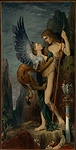
In the meantime, the celebrated Sphinx had appeared in the neighbourhood
of Thebes. She had settled on a rock, and put a riddle to every Theban
that passed by, and whoever was unable to solve it was killed by the monster.
This calamity induced the Thebans to make known that whoever should deliver
the country of it should be made king, and receive Locaste as his wife.
Oedipus was one of those that came forward, and when he approached the
Sphinx she gave him the riddle which he solved, and the Sphinx thereupon
threw herself from the rock. Oedipus now obtained the kingdom of Thebes,
and married his mother, by whom he had issue. In consequence of this incestuous
alliance, of which no one was aware, the country of Thebes was visited
by a plague, and the oracle ordered that the murderer of Laius should
be expelled. Oedipus accordingly pronounced a solemn curse upon the unknown
murderer, and declared him an exile; but when he endeavoured to discover
him, he was informed by the seer Teiresias that he himself was both the
parricide and the husband of his mother. Iocaste now hung herself, and
Oedipus put out his own eyes. A different account of the story tells that
Oedipus in his blindness was expelled from Thebes by his sons and brother-in-law,
Creon, who undertook the government, and he was guided and accompanied
by Antigone in his exile to Attica; but according to others he was imprisoned
by his sons at Thebes, in order that his disgrace might remain concealed
from the eyes of the world. The father now cursed his sons, who agreed
to rule over Thebes alternately, but became involved in a dispute, in
consequence of which they fought in single combat, and slew each other.
Hereupon Creon succeeded to the throne, and expelled Oedipus. After long
wanderings Oedipus arrived in the grove of the Eumenides, near Colonus,
in Attica; he was there honoured by Theseus in his misfortune, and, according
to an oracle, the Eumenides removed him from the earth, and no one was
allowed to approach his tomb. According to Homer, Oedipus, tormented by
the Erinnyes of his mother, continued to reign at Thebes after her death;
he fell in battle, and was honoured at Thebes with funeral solemnities.
Another account states that he was thrown in a chest into the sea when
yet an infant, to have been carried by the waves to the coast of Sicyon,
to have been received by Polybus, and afterwards to have been blinded
by him.


© 2024 The Universal Compendium