
Amazon
Ads |


Simon
(1st century)
Other names: Simon the Canaanite,
Simon the Zealot
Biographical
Nothing is known abut the parentage of Simon.
His name occurs in all the passages of the Gospel and Acts,
in which a list of the Apostles is given. To distinguish him from St Peter
he is called Kananaios, or Kananites, and Zelotes. Both surnames have
the same signification and are a translation of the Hebrew qana
(the Zealous). The name does not signify that he belonged to the party
of Zealots, but that he had zeal for the Jewish law, which he practised
before his call. Jerome and others wrongly assumed that Kana was his native
place; were this so, he should have been called Kanaios. The Greeks, Copts,
and Ethiopians identify him with Nathanael of Cana; the first-mentioned
also identify him with the bridegroom of the marriage of Cana, while in
the Chronicon paschale and elsewhere he is identified with Simon
Clopas. The Ethiopians accordingly relate that he suffered crucifixion
as the Bishop of Jerusalem, after he had preached the Gospel in Samaria.
Where he actually preached the Gospel is uncertain. Almost all the lands
of the then known world, even as far as Britain, have been mentioned;
according to the Greeks, he preached on the Black Sea, in Egypt, Northern
Africa, and Britain, while, according to the Latin Passio Simonis
et Judae — the author of which was (Lipsius maintains) sufficiently
familiar with the history of the Parthian Empire in the first century
— Simon laboured in Persia, and was there martyred at Suanir. However,
Suanir is probably to be sought in Colchis. According to Moses of Chorene,
Simon met his death in Weriosphora in Iberia; according to the Georgians,
he preached in Colchis. His place of burial is unknown. Concerning his
relics the information is as uncertain as concerning his preaching. From
Babylon to Rome and Toulouse we find traces of them; at Rome they are
venerated under the Altar of the Crucifixion in the Vatican.
In Eastern traditions, he is said to have died peacefully.
In the West, he is believed to have died a martyr.
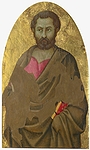
His usual attribute is the saw, since his body was said
to have been sawed to pieces, and more rarely the lance. In the Western
Church he is venerated together with Jude (Thaddaeus); in the East separately.
Simon is the
patron saint of curriers, sawyers, and tanners.
Place of birth: Galilee?
Place of death: Jerusalem?
Place of burial: relics allegedly found in various places, including Rome,
Iraq, and France
© 2024 The Universal Compendium