Amazon
Ads |


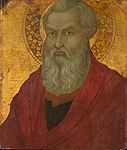
St
Matthew
(1st century)[J92]
Other names: Levi[J92]
Biographical
According to Mark 2:14, Matthew was a son of Alphaeus
(1). He was a portitor, or inferior collector of customs
at Capernaum, on the Sea of Galilee. He was not a publicanus, or general
farmer of customs. We may suppose either that he held his appointment
at the port of Capernaum, or that he collected the customs on the high
road to Damascus, which went through what is now called Khan Minyeh, which
is the ancient Capernaum. Thus, we see that Matthew belonged to the lower
class of people. In Mark 2:14, he is also called Levi. This is not mentioned
in the list of the apostles of Matthew and Luke, but the omission does
not prove the contrary, as we may infer from the fact that Lebbaus is
also called Judas in Luke 6:16, in which verse the name Lebbaus is omitted.
In Matthew 9:9, it is related how Matthew was called to be an apostle.
We must, however, suppose that he was previously acquainted with Jesus,
since we read in Luke 6:13, that when Jesus, before delivering the Sermon
on the Mount, selected twelve disciples, who were to form the circle of
his more intimate associates, Matthew was one of them. After this Matthew
returned to his usual occupation; from which Jesus, on leaving Capernaum,
called him away. On this occasion, Matthew gave a parting entertainment
to his friends. After this event, he is mentioned only in Acts 1:13. According
to a statement in Clemens Alexandrinus, Matthew abstained from animal
food. Hence, some writers have rather hastily concluded that he belonged
to the sect of the Essenes. It is true that the Essenes practised abstinence
in a high degree; but it is not true that they rejected animal food altogether.
Admitting the account in Clemens Alexandrinus to be correct, it proves
only a certain ascetic strictness, of which there occur vestiges in the
habits of other Jews. According to another account, which is as old as
the first century, Matthew, after the death of Jesus, remained about fifteen
years in Jerusalem. This agrees with the statement in Eusebius, that Matthew
preached to his own nation before he went to foreign countries. Rufinus
and Socrates state that he afterwards went into Ethiopia; and other authors
mention other countries. There also he probably preached specially to
the Jews. According to Heracleon (about AD 150), and Clemens Alexandrinus,
Matthew was one of those apostles who did not suffer martyrdom. The genuineness
of the Gospel of St Matthew has been more strongly attacked than that
of any of the three others, as well by external as by internal arguments.
© 2024 The Universal Compendium