Amazon
Ads |


(–<75)
Other names: John
Biographical
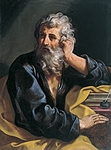
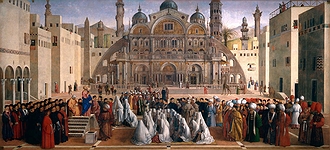
The traditional author of the second Gospel, Mark's name occurs in several books of the New Testament, and doubtless refers in all cases to the same person, though this has been questioned. In the Acts of the Apostles we read of 'John, whose surname was Mark', and gather that Peter was a familiar visitor at the house of his mother Mary, which was a centre of Christian life in Jerusalem. That he was, as his Roman surname would suggest, a Hellenist, follows from the fact that he was also a cousin of Barnabas, who belonged to Cyprus. When Barnabas and Paul returned from their relief visit to Judaea, Mark accompanied them. Possibly he had shown in connexion with their relief work that practical capacity which seems to have been his distinctive excellence. When, not long after, they started on a joint mission beyond Syria, Mark went as their assistant, undertaking the minor personal duties connected with travel, as well as with their work proper. As soon, however, as their plans developed, after leaving Cyprus and on arrival at Perga in Pamphylia, Mark withdrew, probably on some matter of principle, and returned to Jerusalem. When, then, Paul proposed, after the Council of Jerusalem, to revisit with Barnabas the scenes of their joint labours, he naturally demurred to taking Mark with them again, feeling that he could not be relied on should fresh openings demand a new policy. But Barnabas stood by his younger kinsman and 'took Mark and sailed away to Cyprus'. Barnabas does not reappear, unless we trust the tradition which makes him an evangelist in Alexandria. When Mark appears once more, it is in Paul’s company at Rome, as a fellow-worker joining in salutations to Christians at Colossae. We gather, too, that his restoration to Paul’s confidence took place some time earlier, as the Colossians had already been bidden by oral message or letter to welcome him if he should visit them. This points to a reconciliation during Paul’s last sojourn in Jerusalem or Caesarea. Not long after, Mark seems to have been sent by Paul to some place in the province of Asia, lying on the route between Ephesus and Rome. Once more Mark’s name occurs in the New Testament, this time with yet another leader, Peter, the friend of his earliest Christian years in Jerusalem, to whom he attached himself after the deaths of Barnabas and Paul. Peter’s words, 'Mark, my son', show how close was the spiritual tie between the older and the younger man; and as he is writing from Rome, this forms a link between the New Testament and early tradition, which speaks of Mark as an Evangelist writing his Gospel under the influence of Peter’s preaching in Rome. This is the essence of the tradition preserved from 'the elders of former days' by Clement of Alexandria, probably based on Papias’s record of the explanation given by 'the Elder' (John) as to the contrast in form between Mark’s memoirs of Peter’s discourses and the Gospel of Matthew', but defining the place where these memoirs were written as Rome. That he acted to some degree as Peter’s interpreter or dragoman, owing to the apostle’s imperfect mastery of Greek, is held by some but denied by others. His role throughout his career was servus servorum dei; and the fact that he was this successively to Barnabas, Paul and Peter, helps to show the essential harmony of their message. The identification of the author of the second Gospel with Mark, which we owe to tradition, enables us to fill in our picture of him a little further. Thus, it is possible that Mark was himself the youth to whom his Gospel refers as present at Jesus’s arrest. It is probably as an evangelist, and not in his own person, that he became known as 'he of the stunted extremities', a title first found in Hippolytus, in a context which makes its metaphorical reference to his Gospel pretty evident. It was too as an evangelist that he became personally a subject of later interest, and of speculative legends due to this, e.g. he was one of the Seventy, he was the founder of the Alexandrine Church and its first bishop, and was author of the local type of liturgy. As to his last days and death, nothing is really known. It is possible—even probable, if we accept the theory that he had already been there with Barnabas—that Alexandria was his final sphere of work, as the earliest tradition on the point implies, and as was widely assumed in the 4th century. That he died and was buried there is first stated by Jerome, to which his Acts adds the glory of martyrdom. Traditionally, Mark is the first patriarch of the Greek and Coptic Patriarchates of Alexandria, from AD 43 to 61. He is the patron saint of Venice and Aquileia, and his symbol is the lion.
Place of birth: Jerusalem?
Place of death: Alexandria, Egypt (traditionally)
© 2024 The Universal Compendium