Amazon
Ads |


Bishop of Liège
(656–727)
Biographical
Bishop of Liège
Bishop of Maastricht
Apostle of Ardennes and Brabant
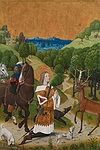
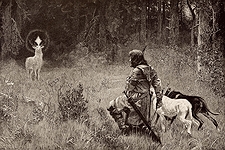
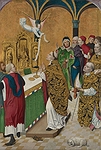
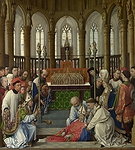
Hubert is frequently said to be of noble ancestry, but this is speculative, with no concrete evidence. He was said to be the son of Bertrand, Duke of Guyenne. As a youth, Hubert went to the court of Neustria, where his charming manners and agreeable address won universal esteem, gave him a prominent position among the gay courtiers, and led to his investment with the dignity of 'count of the palace'. He was a worldling and a lover of pleasure, his chief passion being for the chase, to which pursuit he devoted nearly all his time. The tyrannical conduct of Ebroin caused a general emigration of the nobles and others to the court of Austrasia. Hubert soon followed them and was warmly welcomed by Pepin Heristal, mayor of the palace, who created him almost immediately grand-master of the household. He was said to have married Floribanne, daughter of Dagobert, Count of Louvain, in around 682, and seemed to have given himself entirely up to the pomp and vanities of this world. But a great spiritual revolution was imminent. On Good Friday morning, when the faithful were crowding the churches, Hubert sallied forth to the chase. As he was pursuing a magnificent stag, the animal turned and, as the pious legend narrates, he was astounded at perceiving a crucifix between its antlers, while he heard a voice saying: 'Hubert, unless thou turnest to the Lord, and leadest an holy life, thou shalt quickly go down into hell'. Hubert dismounted, prostrated himself and said, 'Lord, what wouldst Thou have me do?' He received the answer, 'Go and seek Lambert, and he will instruct you.' Accordingly, he set out immediately for Maastricht, of which place St Lambert was then bishop. The latter received Hubert kindly, and became his spiritual director. Hubert, losing his wife shortly after this, renounced all his honours and rank, and distributed all his personal wealth among the poor. He entered upon his studies for the priesthood, was soon ordained, and shortly afterwards became one of St Lambert's chief associates in the administration of his diocese. By the advice of St Lambert, Hubert made a pilgrimage to Rome and during his absence, St Lambert was assassinated by the followers of Pepin. It was said that at the same hour, this was revealed to the pope in a vision, together with an injunction to appoint Hubert bishop, as being a worthy successor to the see. Hubert was so much possessed with the idea of himself winning the martyr's crown that he sought it on many occasions, but unsuccessfully. He distributed his episcopal revenues among the poor, was diligent in fasting and prayer, and became famous for his eloquence in the pulpit. In 720, in obedience to a vision, Hubert translated St Lambert's remains from Maastricht to Liège with great pomp and ceremonial, several neighbouring bishops assisting. A church for the relics was built upon the site of the martyrdom, and was made a cathedral the following year, the see being removed from Maastricht to Liege, then only a small village. This laid the foundation of the future greatness of Liege, of which Lambert was honoured as patron, and St Hubert as founder and first bishop. Idolatry still lingered in the fastnesses of the forest of Ardennes—in Toxandria, a district stretching from near Tongres to the confluence of the Waal and the Rhine, and in Brabant. At the risk of his life, Hubert penetrated the remote lurking places of paganism in his pursuit of souls, and finally brought about the abolishment of the worship of idols in his neighbourhood. Hubert travelled to the town of Fura for the dedication of a new church. Being apprised of his impending death by a vision, he there preached his valedictory sermon, fell sick almost immediately, and in six days died. His body was deposited in the collegiate church of St Peter, Liège. It was solemnly translated in 825 to the Abbey of Amdain, later renamed St Hubert's, but the coffin disappeared in the sixteenth century. St Hubert was widely venerated in the Middle Ages, and many military orders were named after him. He was honoured as the patron of huntsmen, and the healer of rabies.
Place of death: Fura
Place of burial: Abbey of Andagium, St-Hubert-des-Ardennes (previously, St Peter's Liège)
© 2024 The Universal Compendium