Amazon
Ads |


(c.480–544)
Biographical
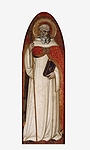
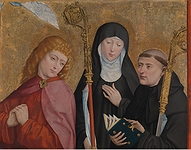
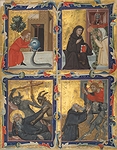
Founder of the Benedictines, and the patriarch of Western monks, the only authority for the facts of St Benedict’s life is Book II of St Gregory’s Dialogues. St Gregory declares that he obtained his information from four of St Benedict’s disciples, whom he names; and there can be no serious reason for doubting that it is possible to reconstruct the outlines of St Benedict’s career. A precise chronology and a pedigree have been supplied for Benedict, according to which he was born in 480, of the great family of the Anicii; but all we know is what St Gregory tells us, that he was born of good family in Nursia, near Spoleto in Umbria. His birth must have occurred within a few years of the date assigned; the only fixed chronological point is a visit of the Gothic king Totila to him in 543, when Benedict was already established at Monte Cassino and advanced in years. He was sent by his parents to frequent the Roman schools, but shocked by the prevailing licentiousness, he fled away. It has been usual to represent him as a mere boy at this time, but of late years various considerations have been pointed out which make it more likely that he was a young man. He went to the mountainous districts of the Abruzzi, and at last came to the ruins of Nero’s palace and the artificial lake at Subiaco, 40 miles from Rome. Among the rocks on the side of the valley opposite the palace he found a cave in which he took up his abode, unknown to all except one friend, Romanus, a monk of a neighbouring monastery, who clothed him in the monastic habit and secretly supplied him with food. Sacro Speco is the cave where Benedict spent the three years of opening manhood in solitary prayer, contemplation, and austerity. After this period of formation his fame began to spread abroad, and the monks of a neighbouring monastery induced him to become their abbot; but their lives were irregular and dissolute, and on his trying to put down abuses they attempted to poison him. He returned to his cave, but disciples flocked to him, and in time he formed twelve monasteries in the neighbourhood, placing twelve monks in each, and himself retaining a general control over all. In time patricians and senators from Rome entrusted their young sons to his care, to be brought up as monks; in this manner came to him his two best-known disciples, Maurus and Placidus. Driven from Subiaco by the jealousy and molestations of a neighbouring priest, but leaving behind him communities in his twelve monasteries, he himself, accompanied by a small band of disciples, journeyed south until he came to Cassino, a town halfway between Rome and Naples. Climbing the high mountain that overhangs the town, he established on the summit the monastery with which his name has ever since been associated, and which for centuries was a chief centre of religious life for Western Europe. He destroyed the remnants of paganism that lingered on here, and by his preaching gained the rustic population to Christianity. Few other facts of his career are known: there is record of his founding a monastery at Terracina; his death must have occurred soon after Totila’s visit in 543. His remains were allegedly removed to Fleury in France, 703. St Benedict was the twin brother of St Scholastica. He is the patron saint against poisoning and witchcraft; of speleologists, and of Europe.
Place of birth: Nursia
Place of death: Monte Cassino
Place of burial (last known): Monte Cassino

© 2024 The Universal Compendium