|
Two unified Thai kingdoms emerged in the mid-13th century.
The Sukhothai, located in the south-central plains, gained
its independence from the Khmer Empire to the east. By the
late 13th century, Sukhothai’s territory extended into
present-day Burma and Laos. Sukhotai lasted until the mid-15th
century. The Thai Lan Na Kingdom was established in the north,
with its capital at Chang Mai. Lan Na was conquered by the
Burmese in the 16th century. The Ayutthaya Kingdom (14th-18th
centuries) succeeded the Sukhothai and would become known
as the Siamese Kingdom. During the Ayutthaya period, the Thai/Siamese
peoples consolidated their hold on what is present-day central
and north-central Thailand. Following a military defeat at
the hands of the Burmese in 1767, the Siamese Kingdom rose
to new heights under the military ruler Taksin, who defeated
the Burmese occupiers and expanded the kingdom’s territory
into modern-day northern Thailand (formerly the Lan Na Kingdom),
Cambodia, Laos, and the Malay Peninsula. The kingdom fought
off additional Burmese invasions and raids in the late 1700s
and early 1800s. In the mid-1800s, Western pressure led to
Siam signing trade treaties that reduced the country’s
sovereignty and independence. In the 1890s and 1900s, the
British and French forced the kingdom to cede Cambodian, Laotian,
and Malay territories that had been under Siamese control.
A bloodless revolution in 1932 led to the establishment of
a constitutional monarchy. After the Japanese invaded Thailand
in 1941, the government split into a pro-Japan faction and
a pro-Ally faction backed by the king. Following the war,
Thailand became a US treaty ally in 1954 after sending troops
to Korea and later fighting alongside the US in Vietnam. Thailand
since 2005 has experienced several rounds of political turmoil,
including a military coup in 2006 that ousted then Prime Minister
Thaksin Shinawatra, followed by large-scale street protests
by competing political factions in 2008, 2009, and 2010. Thaksin's
youngest sister, Yingluck Shinawatra, in 2011 led the Puea
Thai Party to an electoral win and assumed control of the
government.
In early May 2014, after months of large-scale anti-government
protests in Bangkok beginning in November 2013, Yingluck was
removed from office by the Constitutional Court and in late
May 2014 the Royal Thai Army, led by Royal Thai army general
Prayut Chan-o-cha, staged a coup against the caretaker government.
The military-affiliated National Council for Peace and Order
(NCPO), led by Prayut as the appointed minister, ruled the
country for more than four years, during which time the NCPO
drafted a new constitution guaranteeing military sway over
Thai politics in future elections by allowing the military
to appoint the entire 250-member Senate and requiring a joint
meeting of the House and Senate to select the prime minister,
effectively giving the military a veto over the top executive.
King Bhumibol Adulyadej died in October 2016 after 70 years
on the throne; his only son, Vajiralongkorn (aka King Rama
X), ascended the throne in December 2016. He signed the new
constitution in April 2017. A long-delayed election in March
2019, disputed and widely viewed as skewed in favour of the
party aligned with the military, allowed Prayut to continue
his premiership. The country experienced large-scale pro-democracy
protests in 2020.
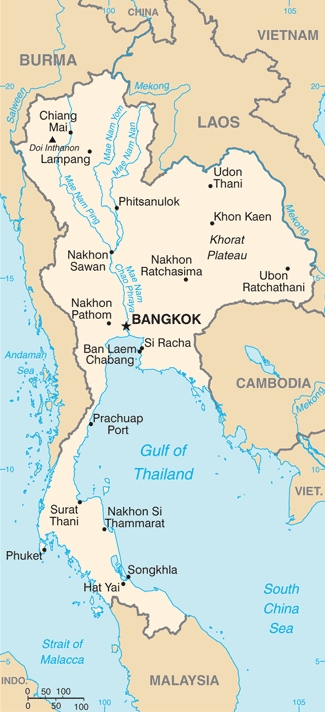
Location: South-eastern Asia, bordering the Andaman Sea and
the Gulf of Thailand, southeast of Burma.
|