Amazon
Ads |


(c. 186–253)
Other names: Origen Adamatius
Biographical
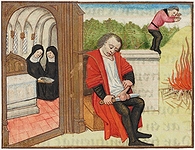
The son of St Leonides of Alexandria, Origen was one of the most remarkable, eloquent, and influential of the early Christian writers styled the 'Fathers'. He was a pupil of Clement of Alexandria, and became versed in grammar, rhetoric, logic, geometry, music, and philosophy. At the age of eighteen he was appointed by Bishop Demetrius to the office of catechist, the duties of which he performed with zeal and self-denial. He became very ascetic in his course of life, and mortified himself by a form of self-mutilation which he supposed to be recommended in Matthew 19:12. Having learned the Hebrew language, he devoted himself to biblical studies. While passing through Palestine on a journey, about 228 or 230, he was ordained a presbyter at Caesarea. This is said to have aroused the jealousy of Demetrius, Bishop of Alexandria, who excommunicated him and induced the Bishop of Rome and of other churches to concur in this sentence. In 231 Origen removed to Caesarea, where he acquired a high reputation as a preacher and commentator on Scripture. That he might be better qualified to make proselytes, he studied the Greek philosophy, of which he adopted the more noble and beautiful dogmas, and attempted to harmonise Platonism with Christianity. He made an innovation (which many think dangerous) in the mode of interpreting Scripture. His desire to find a mystical sense led him frequently into a neglect of the historical sense. In 235 he sought refuge from persecution in Cappadocia. He compiled about this time a valuable edition of the Old Testament, entitled 'Hexapla', which exhibits in six columns the Hebrew text and various Greek versions. Fragments of the 'Hexapla' have been preserved in the writings of the Fathers. He afterwards wrote an able defence of Christianity against Celsus, an Epicurean philosopher, which is still extant. Decius having renewed the persecution of the Christians in 250 AD, Origen was imprisoned and subjected to torture, but survived, and was released a short time before his death, which occurred at Tyre in 253. The greater part of his numerous works are lost. His opinions gave rise to a great controversy long after his death. He held the doctrine of the universal restoration of sinners, and was charged with teaching the heretical notions which, after his time, prevailed under the name of Aryanism. His defenders affirmed that the passages on which this charge was founded had been interpolated in his works. About the end of the fifth century, Origenism prevailed in Egypt and Syria, but it was condemned by the Council of Constantinople in 553.
Place of birth: Alexandria?
Place of death: Tyre
© 2024 The Universal Compendium