|
Azerbaijan, a secular nation with a majority-Turkic and majority-Shia
Muslim population, was briefly independent (from 1918 to 1920)
following the collapse of the Russian Empire; it was subsequently
incorporated into the Soviet Union for seven decades. Azerbaijan
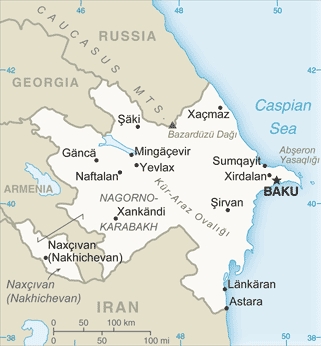
remains involved in the protracted Nagorno-Karabakh conflict
with Armenia. Nagorno-Karabakh was a primarily ethnic Armenian
region that Moscow recognized in 1923 as an autonomous oblast
within Soviet Azerbaijan. In the late Soviet period, a separatist
movement developed which sought to end Azerbaijani control
over the region. Fighting over Nagorno-Karabakh began in 1988
and escalated after Armenia and Azerbaijan attained independence
from the Soviet Union in 1991. By the time a ceasefire took
effect in May 1994, separatists, with Armenian support, controlled
Nagorno‑Karabakh and seven surrounding Azerbaijani territories.
Following a Second Nagorno-Karabakh War that took place in
September-November 2020, Azerbaijan recaptured much of the
territory it had lost a quarter-century earlier and under
the terms of a cease fire agreement, Armenia returned the
remaining territories it occupied to Azerbaijan.
In the 25 years following its independence, Azerbaijan succeeded
in significantly reducing the poverty rate and has directed
revenues from its oil and gas production to develop the country's
infrastructure. However, corruption remains a problem, and
the government has been accused of authoritarianism. The country's
leadership has remained in the Aliyev family since Heydar
Aliyev became president in 1993 and was succeeded by his son,
President Ilham Aliyev in 2003. Following two national referendums
in the past several years that eliminated presidential term
limits and extended presidential terms from 5 to 7 years,
President Aliyev secured a fourth term as president in April
2018 in an election that international observers noted had
serious shortcomings. Reforms are underway to diversify the
country's non-oil economy and additional reforms are needed
to address weaknesses in government institutions, particularly
in the education and health sectors, and the court system.
Location:
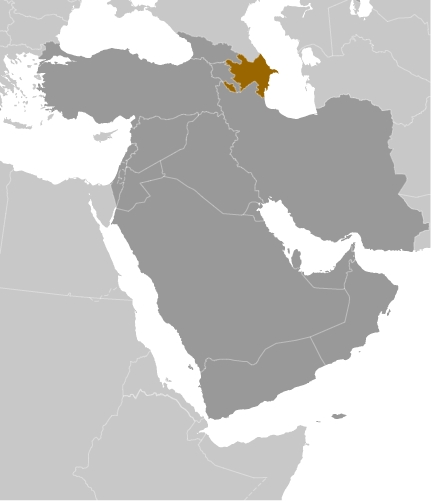
South-western Asia, bordering the Caspian Sea, between Iran
and Russia, with a small European portion north of the Caucasus
range.
|