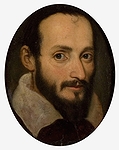
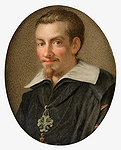
Francesco
Vanni
(1563–1610)
Other names: Pierfrancesco (at baptism)
Biographical
Knight of the Supreme Order of Christ [Vatican]
Vanni's early life was marked by the premature death of his father,
after which his mother remarried the Sienese painter Arcangelo Salimbeni,
who played a crucial role in shaping Vanni’s artistic development.
Growing up in this creative environment, he trained alongside his
half-brother Alessandro under Salimbeni’s guidance, refining
his skills and developing a keen understanding of painting. In 1580,
he became a member of the Congregation of the Sacred Nail, a religious
confraternity that granted him valuable connections with Siena’s
ecclesiastical elite, helping him secure significant commissions that
would launch his career. During the early 1580s, he is believed to
have spent time in Rome, where he was exposed to the latest artistic
innovations, including the dynamic compositions and expressive figures
characteristic of the evolving Baroque style. His career flourished
under the patronage of influential figures such as Cardinals Cesare
Baronio and Paolo Emilio Sfondrato, both of whom were deeply involved
in the artistic programmes of the Counter-Reformation and played a
key role in directing his commissions. Returning to Siena, he gained
increasing recognition, and by the 1590s, his style had matured, blending
the elegant refinement of Sienese traditions with the dramatic influence
of Roman and Bolognese art. This synthesis allowed him to secure prestigious
commissions in Siena and beyond, including in cities such as Rome,
Lucca, and Pisa. His reputation grew considerably, earning him the
admiration of his contemporaries as well as significant honours. Highly
esteemed in his lifetime, his drawings were sought after and collected
by notable figures, including Cardinal Leopoldo de’ Medici.
,As one of the leading painters of his time, Vanni worked at the intersection
of late Mannerism and the early Baroque, playing a key role in preserving
and revitalising Sienese artistic traditions while simultaneously
engaging with the broader stylistic currents of Italy. His influence
extended beyond his lifetime, as his works and artistic approach continued
to inspire later generations of painters. He remained active until
his death.
Place of birth: Siena
Place of baptism: Parish of St John the Baptist
Place of death: Siena
Place of burial: Church of San Giorgio
Son of Eugenio di Giovanni Vanni and Battista di Vittorio Focari,
he was married firstly to Aurora Amaroni in 1580, and secondly to
Caterina Rossetti in 1584, and had issue by his second wife.