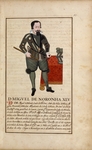
Miguel de Noronha
1st Conde de Linares
(c. 1585–1647)
Biographical
1st
Conde de Linares 1643-47† [Spain]
4th Conde de Linhares
1608–47† (titular from 1643) [Portugal]
1st Duque de Viseu
[Spain]
1st Marques de Gijón
[Spain]
Senhor de Fornos
Senhor de Algodres
Senhor de Peña Verde
Viceroy of India 1629–35
Cr. Squire in Portugal (fidalgo escudiero)
Cr. Noble in Portugal (fidalgo) 1602
Governor of Pernambuco 1637
Governor of Tangiers 1624–28
Captain General of Tangiers 1624–28
State Councillor [Portugal]
Captain General of the Ocean Sea Fleet
Captain General of the Galleys of Spain
Captain General of the Galleys of Sicily
Commander of Noudar in the Order of Avis
Commander of Barrancos in the Order of Avis
Alcaide-mor of Viseu
Gentleman of the Chamber to Felipe IV of Spain
1637
In 1610, Miguel served in North Africa, first in Ceuta, where he remained
for more than three years, and later in Tangier, where he spent two
and a half years. Appointed Viceroy of India, he departed in 1629.
Upon his arrival in Goa, he assumed office and offered to send military
assistance to Nuno Álvares Botelho, who had exercised interim
authority until his arrival and was defending Malacca. During his
viceroyalty, Miguel conquered the city of Kambolim, and Ceilão
was recovered, although he lost Mombasa to the Dutch. He also had
serious disputes with the fathers of the Society of Jesus and attempted
to restore order to the Portuguese administration. In 1635, he handed
over the government of India to his successor, Pedro da Silva. After
his return to Portugal, Miguel was offered the governorship of Brazil,
which he declined. In 1637, he opposed Olivares’s policies in
Portugal and advocated negotiation during the Évora revolt.
He was appointed governor of Pernambuco, which was almost entirely
under Dutch control. He initially tried to refuse the appointment
but was ultimately forced to accept it. As governor, he failed in
his negotiations with the rebels at Évora and had to withdraw
hastily, subsequently falling out of favour at court and being sent
to Tordesillas. He regained his influence years later and was appointed
to various posts. Miguel remained in Spain, serving the royal court
after Portugal’s separation from the Spanish monarchy.
Place of death: Madrid
Son of Afonso de Noronha and Arcângela
de Portugal (Noronha),
he married Inácia de Noronha, with issue
• Fernando (see)
Miguel was married secondly to Lucrecia de Silva