(2433)
|
Amazon Ads |


Raja of Jodhpur
(1629–78)
Positions Held
Viceroy of Malwa 1658
Biographical
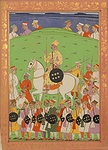
The celebrated Raja of Jodhpur or Marwar, of the tribe of Rathor rajputs, Jaswant Singh acted so capital a part in the competitions of Aurangzeb and his brother Dara Shikoh whose cause he espoused, and was guilty of great impropriety. He ascended the throne of Jodhpur on the death of his father Raja Guj Singh in 1638. He was the younger brother of the famous Amar Singh Rathore. The young prince had already seen a good deal of active service in the incessant war which the Great Mughal was waging in the Deccan. In the wars of Gondwana, Ahmadnagar and Bijapur, he gave ample proofs of his gallantry. He was always to be seen in the thickest of the fight vigorously applying his khanda on the heads of the Deccani foe with the inimitable rapidity of the rajput swordsman. His frame was tall and athletic. He scorned all danger in the field. The sensation of fear was an absolute stranger to him. In addition to his personal daring in war he possessed clear brains and an unconquerable determination. Prince Aurangzeb, who commanded the Mughal armies in the Deccan, grew to respect and fear him. The latter feeling was intensified on his accession to the throne of Delhi and was abundantly manifested. Jaswant Singh was also a patron of literature at home. His various admirable qualities enabled him to fully maintain the honourable traditions of his noble house and the martial Rathor race.
Jaswant Singh was favoured by emperor Shah Jahan and was chosen by him to lead the forces against Aurangzeb at the battle of Dharmatpur in 1658, but he suffered a devastating defeat with heavy casualties, and was forced to retreat. He returned to his country, but his wife, repudiated him and ordered the fortress closed, refusing his entry. She sent him a letter stating: 'From this day he is no longer my husband, and I never want to see his face again. As a descendant of the great Rana, his soul should not have been thus vile; he ought to have recollected his connection with our illustrious house. His business was to gain the battle or die on the spot; then should I have acquired one of two glorious things the renown of being a hero's wife, or an honoured widow's death by burning.' After Aurangzeb had ascended the throne, he sought to reconcile her with her husband, and she accepted albeit reluctantly.
After his victory, Aurangzeb brought round Jaswant Singh who accepted his proposals and he proceeded to join Aurangzeb's army which was advancing to meet the forces of Shujah Khan, the Mugal viceroy of Gujrat. The two armies met at Kujwa early in January 1659, but in an act of revenge against Aurangzeb, Jaswant Singh, along with the rajputs, turned on the rearguard of the Imperial army, plundering the equipage and military store, and they headed for Agra to meet with Dara Shikoh's army. However, after Aurangzeb had defeated Shujah Khan, Dara Shikoh failed to appear and Jaswant Singh, greatly disappointed, returned to Marwar with his spoils. Aurangzeb pardoned him in exchange for his support in the battle against Sivaji in the Deccan. Again, Jaswant Singh sought revenge by joining the plot to assassinate Aurangzeb's uncle, Shaista Khan. Again Aurangzeb pardoned him and appointed him to lead the Mughal armies in the Deccan.
Jaswant Singh was soon involved in another plot against Aurangzeb, this time, taking up the cause of Prince Muazzam. Aurangzeb had fallen seriously ill and Muazzam sought to succeed him. But Aurangzeb recovered, and finally decided to have Jaswant Singh eliminated. Two attempts to have him murdered failed. Aurangzeb then appointed him his viceroy in 1678 against the Afghan and Uzbeks who were rebelling; in reality, a trap so that he and his forces would be sent to the perilous Afghan regions and abandoned there. As the rajput forces were being thinned out in Afghanistan, Jaswant Singh's son, Pirthi Singh, who had been left behind at Jodhpur, was invited to the court of Aurangzeb. A poisoned robe of honour was bestowed on the unsuspecting prince, and within hours, he was dead. Jaswant Singh's two other young sons perished in Kabul. On the 10th of December 1678, Aurangzeb had Jaswant Singh poisoned at Jamrud. In 1679, Jaswant Singh's queen gave birth to a posthumous son, Ajit Singh, at Lahore.
After his death, Jaswant Singh's followers brought his son and his women who did not burn with him, towards their native country. Orders were sent by the emperor Aurangzeb to conduct them to court, where, on their arrival, he insisted that Ajit Singh convert to Islam. Upon this the rajput attendants determined to die rather than submit to this order, fled with their charge towards the Raja's territories, and being pursued by the emperor's troops fought valiantly, and were mostly cut to pieces, but the women and infants arrived safe at Jodhpur; they were, however, compelled to take refuge in the hills and the woods, and on the death of Aurangzeb 1707, regained their former possession. Ajit Singh was restored to the throne of his ancestors in the 1711, by the emperor Farrukhsiyar who married his daughter.
Place of death: Kabul
 |
Sources
1. H.G. Keene; T.W. Beale. An Oriental Biographical Dictionary Founded on Materials Collected by Thomas William Beale. London: W. H. Allen & Co., Limited, 1894.
2. R. Watercamp. Rajasthan Mit Delhi, Agra, Varanasi, Khajuraho und den Höhlen bei Aurangabad. Berlin: Trescher Verlag, 2018.
3. N. Manucci; W. Irvine. Storia do Mogor: or, Mogul India, 1653–1708, vol. 1, trans. W. Irvine. London: John Murray, 1907.
4. Hem Chandra Rai. Flowers of Hindu Chivalry. Delhi: Bharat Printing Works. Bazar Sitaram, 1932.
Families | Lands | Abbreviations and Symbols
© 2024 The Universal Compendium