
|
|
|
|||||||||
 |
||||||||||
| (2173) | ||||||||||
| Anne
of Cleves
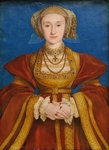
(1515–57) Biographical Henry VIII’s marriage to Anne of Cleves was arranged as a diplomatic strategy rather than a romantic decision, with Thomas Cromwell promoting the alliance to strengthen England’s position through Anne’s brother, William, Duke of Cleves, a Protestant ruler in western Germany. Henry feared a possible alliance between France and the Holy Roman Empire against Protestant England, so the union was meant to secure support among opponents of Emperor Charles V. Anne had been brought up in a secluded household, spoke no language fluently other than her own, had no beauty or accomplishments, and brought no dowry, her only merits being her skill in needlework and her mild, gentle temperament. Nevertheless, her portrait, painted by Holbein at the king’s command, pleased Henry, and the marriage was arranged, with the treaty signed in September 1539. Anne arrived in England in January 1540 and upon meeting, Henry was so taken aback by her appearance that he forgot to give the present he had brought for her, though he still managed to treat her with courtesy. The next day he openly expressed his dissatisfaction with her looks, saying she was no better than a Flanders mare, her manners, and that she spoke limited English. The attempt to prove a pre-contract with the son of the Duke of Lorraine failed, and Henry was left to accept the marriage. On the wedding morning, he declared that nothing on earth would have persuaded him to marry her except the fear of driving the Duke of Cleves into the arms of the Emperor. When the expected Catholic threat did not arise, the marriage lost its political value and was annulled by the Anglican clergy. Cromwell’s fall followed, and, with the main obstacle to ending the marriage removed, Henry declared that the marriage had not been and could not be consummated, and openly cast doubt on his wife’s honour. In July the marriage was declared null and void by Convocation, and an Act of Parliament confirming this was passed immediately afterwards. Henry soon married Catherine Howard. On first hearing of the king’s intentions, Anne fainted, but on recovering she said her situation was very hard and sorrowful because of her great love for the king, and she quietly accepted the arrangements made for her by Henry, receiving lands worth £4,000 a year, giving up the title of queen for that of the king’s sister, and agreeing not to leave the kingdom. In a letter to her brother, drawn up by Gardiner at the king’s direction, she accepted that the marriage had not been valid and acknowledged the king’s kindness and generosity. Anne spent the rest of her life in England at Richmond or Bletchingley, occasionally visiting the court, and was described as cheerful and wearing new dresses every day; an attempt to have her reinstated after Catherine Howard’s disgrace failed, and there was no truth in the rumour that she had given birth to a child said to be Henry’s, and she was present at Henry’s marriage to Catherine Parr and at the coronation of Mary. Place of birth: Düsseldorf Place of marriage: Greenwich Palace, Kent Place of death: Chelsea Old Palace, London Place of burial: Westminster Abbey Daughter of Johann III, Duke of Cleves and Marie von Jülich, she was married to Henry VIII of England in 1540 (annulled 1540) with no issue. |
||||||||||
| |
||||||||||
 |
||||||||||
| |
||||||||||
 |
||||||||||
|
||||||||||


