(2107)
Amazon
Ads |
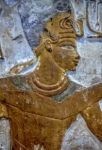


Cleopatra
VII
Queen of Egypt
(69–30 BC)
Other names: Cleopatra VII Thea Philopator, Cleopatra VI
Biographical
Queen of Egypt, jointly 51–48 BC dep, jointly 47–30 BC†
The third
and eldest surviving daughter of Ptolemy Auletes, Cleopatra was seventeen
at the death of her father, who in his will appointed her heir of his
kingdom in conjunction with her younger brother, Ptolemy, whom she was
to marry. The personal charms, for which she was so famed, showed themselves
in early youth, as we are told by Appian that she made an impression on
the heart of Antony in her fifteenth year, when he was at Alexandria
with Gabinius. Her joint reign did not last long, as Ptolemy, or rather
Pothinus and Achillas, his chief advisers, expelled her from the throne,
about b. c. 49. She retreated into Syria, and there collected an army
with which she designed to force her brother to reinstate her. But an
easier way soon presented itself; for in the following year Caesar arrived
in Egypt in pursuit of Pompey, and took upon himself to arrange matters
between Cleopatra and her brother. Being informed of Caesar's amatory
disposition, she resolved to avail herself of it, and, either at his request,
according to Plutarch, or of her own accord, clandestinely effected an
entrance into the palace where he was residing, and by the charms of her
person and voice and the fascination of her manner, obtained such an ascendancy
over him, that, in the words of Dion Cassius, from being the judge between
her and her brother, he became her advocate. According to Plutarch, she
made her entry into Caesar's apartment in a bale of cloth, which was brought
by Apollodorus, her attendant, as a present to Caesar. However this may
be, her plan fully succeeded, and we find her replaced on the throne,
much to the indignation of her brother and the Egyptians, who involved
Caesar in a war in which he ran great personal risk, but which ended in
his favour. In the course of it, young Ptolemy was killed, probably drowned
in the Nile, and Cleopatra obtained the undivided rule. She was however
associated by Caesar with another brother of the same name, and still
quite a child, with a view to conciliate the Egyptians, with whom she
appears to have been very unpopular and she was also nominally married
to him.
While Caesar was in Egypt, Cleopatra lived in undisguised connexion with
him, and would have detained him there longer, or have accompanied him
at once to Rome, but for the war with Pharnaces, which tore him from her
arms. She however joined him in Rome, in company with her nominal husband,
and there continued the same open intercourse with him, living in apartments
in his house, much to the offence of the Romans. (Doubts have been thrown
on her visit to Rome, but the evidence of Cicero, of Dion Cassius, and
Suetonius, seems to be conclusive.) She was loaded with honours and presents
by Caesar, and seems to have stayed at Rome till his death in 44 BC. She
had a son by him, named Caesarion, who was afterwards put to death by
Augustus. Caesar at least owned him as his son, though the paternity was
questioned by some contemporaries; and the character of Cleopatra perhaps
favours the doubt. After the death of Caesar, she fled to Egypt, and in
the troubles which ensued she took the side of the triumvirate, and assisted
Dolabella both by sea and land, resisting the threats of Cassius, who
was preparing to attack her when he was called away by the entreaties
of Brutus. She also sailed in person with a considerable fleet to assist
Antony after the defeat of Dolabella, but was prevented from joining
him by a storm and the bad state of her health. She had however done sufficient
to prove her attachment to Caesar's memory (which seems to have been sincere),
and also to furnish her with arguments to use to Antony, who in the end
of the year 41 came into Asia Minor, and there summoned Cleopatra to attend,
on the charge of having failed to cooperate with the triumvirate against
Caesar's murderers. She was now in her twenty-eighth year, and in the
perfection of matured beauty, which in conjunction with her talents and
eloquence, and perhaps the early impression which we have mentioned, completely
won the heart of Antony, who henceforth appears as her devoted lover
and slave. We read in Plutarch elaborate descriptions of her well-known
voyage up the Cydnus in Cilicia to meet Antony, and the magnificent entertainments
which she gave, which were remarkable not less for good taste and variety
than splendour and profuse expense. One of these is also celebrated in Athenaeus. The first use Cleopatra made of her influence was to procure
the death of her younger sister Arsinoë, who had once set up a claim to
the kingdom. Her brother, Ptolemy, she seems to have made away with before
by poison. She also revenged herself on one of her generals, Serapion,
who had assisted Cassius contrary to her orders, and got into her hands
a person whom the people of Aradus had set up to counterfeit the elder
of her two brothers, who perished in Egypt. All these were torn from the
sanctuaries of temples; but Antony, we learn from both Dion and Appian,
was so entirely enslaved by Cleopatra's charms, that he set at nought
all ties of religion and humanity.
Cleopatra now returned to Egypt, where Antony spent some time in her
company; and we read of the luxury of their mode of living, and the unbounded
empire which she possessed over him. The ambition of her character, however,
peeps out even in these scenes, particularly in a fishing anecdote recorded
by Plutarch. Her connexion with Antony was interrupted for a short time
by his marriage with Octavia, but was renewed on his return from Italy,
and again on his return from his Parthian expedition, when she went to
meet him in Syria with money and provisions for his army. He then returned
to Egypt, and gratified her ambition by assigning to her children by him
many of the conquered provinces. According to Josephus, during Antony's
expedition Cleopatra went into Judaea, part of which Antony had assigned
to her and Herod necessarily ceded, and there attempted to win Herod by
her charms, probably with a view to his ruin, but failed, and was in danger
of being put to death by him. The report, however, of Octavia's having
left Rome to join Antony, made Cleopatra tremble for her influence, and
she therefore exerted all her powers of pleasing to endeavour to retain
it, and bewailed her sad lot in being only regarded as his mistress, and
therefore being liable to be deserted at pleasure. She feigned that her
health was suffering, in short, put forth all her powers, and succeeded.
From this time Antony appears quite infatuated by his attachment, and
willing to humour every caprice of Cleopatra. We find her assuming the
title of Isis, and giving audience in that dress to ambassadors, that
of Osiris being adopted by Antony, and their children called by the title
of the sun and the moon, and declared heirs of unbounded territories.
She was saluted by him with the title of Queen of Queens, attended by
a Roman guard, and Artavasdes, the captive king of Armenia, was ordered
to do her homage. One can hardly wonder that Augustus should represent
Antony to the Romans as 'bewitched by that accursed Egyptian'; and he
was not slow in availing himself of the disgust which Antony's conduct
occasioned to make a determined effort to crush him.
War, however, was declared against Cleopatra, and not against Antony,
as a less invidious way. Cleopatra insisted on accompanying Antony in
the fleet; and we fnd them, after visiting Samos and Athens, where they
repeated what Plutarch calls the farce of their public entertainments,
opposed to Augustus at Actium. Cleopatra indeed persuaded Antony to retreat
to Egypt, but the attack of Augustus frustrated this intention, and the
famous battle of 31 BC took place in the midst of which, when fortune
was wavering between the two parties, Cleopatra, weary of suspense, and
alarmed at the intensity of the battle, gave a signal of retreat to her
fleet, and herself led the way. Augustus in vain pursued her, and she
made her way to Alexandria, the harbour of which she entered with her
prows crowned and music sounding, as if victorious, fearing an outbreak
in the city. With the same view of retaining the Alexandrians in their
allegiance, she and Antony (who soon joined her) proclaimed their children, Antyllus and Cleopatra, of age. She then prepared to defend herself in
Alexandria, and also sent embassies to the neighbouring tribes for aid.
She had also a plan of retiring to Spain, or to the Persian gulf; and
either was building ships in the Red Sea, as Dion asserts, or, according
to Plutarch, intended to draw her ships across the isthmus of Suez. Whichever
was the case, the ships were burnt by the Arabs of Petra, and this hope
failed. She scrupled not to behead Artavasdes, and send his head as a
bribe for aid to the king of Media, who was his enemy. Finding, however,
that no aid was forthcoming, she prepared to negotiate with Augustus,
and sent him on his approach her sceptre and throne (unknown to Antony),
as thereby resigning her kingdom. His public answer required her to resign
and submit to a trial; but he privately urged her to make away with
Antony,
and promised that she should retain her kingdom. On a subsequent occasion. Thyrsus, Caesar's freedman, brought similar terms, and represented Augustus
as captivated by her, which she seems to have believed, and, seeing
Antony's
fortunes desperate, betrayed Pelusium to Augustus, prevented the Alexandrians
from going out against him, and frustrated Antony's plan of escaping
to Rome by persuading the fleet to desert him. She then fled to a mausoleum
she had built, where she had collected her most valuable treasures, and
proclaimed her intention of putting an end to her life, with a view to
entice Antony there, and thus ensure his capture. (This is the account
of Dion Cassias; the same facts for the most part are recorded by Plutarch,
who however represents Cleopatra's perfidy as less glaring.) She then
had Antony informed of her death, as though to persuade him to die with
her; and this stratagem, if indeed she had this object, fully succeeded,
and he was drawn up into the unfinished mausoleum, and died in her arms.
She did not however venture to meet Augustus, though his rival was dead,
but remained in the mausoleum, ready if need was to put herself to death,
for which purpose she had asps and other venomous animals in readiness.
Augustus contrived to apprehend her, and had all instruments of death
removed, and then requested an interview. The charms of Cleopatra, however,
failed in softening the colder heart of Augustus. He only 'bade her be
of good cheer, and fear no violence'. Seeing that her case was desperate,
and determined at all events not to be carried captive to Rome, she resolved
on death; but in order to compass this, it was necessary to disarm the
vigilance of her jailers, and she did this by feigning a readiness to
go to Rome, and preparing presents for Livia, the wife of Augustus.This
artifice succeeded, and she was thereby enabled to put an end to her life,
either by the poison of an asp, or by a poisoned comb; the former supposition
being adopted by most writers. At the age of 39, Cleopatra was dead, and
with her ended the dynasty of the Ptolemies in Egypt.
The leading points of Cleopatra's character were, ambition and voluptuousness.
History presents to us the former as the prevailing motive, the latter
being frequently employed only as the means of gratifying it. In all the
stories of her luxury and lavish expense, there is a splendour and a grandeur
that somewhat refines them. In the days of her prosperity, her arrogance
was unbounded, and she loved to swear by the Capitol, in which she hoped
to reign with Antony. She was avaricious, to supply her extravagance,
and cruel, or at least had no regard for human life when her own objects
were concerned. Her talents were great and varied; her knowledge of languages
was peculiarly remarkable of which she had seven at command, and was the
more remarkable from the fact that her predecessors had not been able
to master even the Egyptian language, and some had forgotten their native
Macedonian; and in the midst of the most luxurious scenes we see traces
of a love of literature and critical research. She added the library of Pergamus, presented to her by
Antony, to that of Alexandria. Her ready
and versatile wit, her knowledge of human nature and power of using it,
her attractive manners, and her exquisitely musical and flexible voice,
compared by Plutarch to a many-stringed instrument, are also the subjects
of well-attested praise. The higher points in her character are admirably
touched by Horace in an ode on her defeat.
Daughter of Ptolemy XII, King of Egypt, and possibly Cleopatra V Tryphaena.
She was possibly married firstly to her brother, Ptolemy XIII, in 51 BC;
secondly to another brother, Ptolemy XIV, in 47 BC;
thirdly to Mark Antony in 32 BC,
by whom she had issue before their marriage; she also apparently had illegitimate
issue by Julius Caesar.
 |
 |
Sources
1. Sir William Smith, ed. Dictionary of Greek and Roman Biography and Mythology, vol. 1. Boston: Little, Brown & Co., 1870.
2. Encyclopaedia Britannica. Chicago: Encyclopaedia Britannica, 2018.
3. George Childs Kohn. Dictionary of Wars. Chicago; London: Fitzroy Dearborn, 1999.
Families | Lands | Abbreviations and Symbols
© 2024 The Universal Compendium