
|
|
|
|||||||||
 |
||||||||||
| (1494.2) | ||||||||||
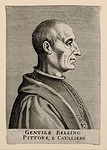
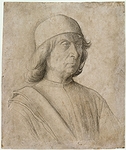
| Gentile
Bellini
(>1432–1507) Biographical Count Palatine 1481 [Turkey] 'Miles Auratus' 1481 [Turkey] 'Venetus Eques' 1469 [HRE] Imperial Count Palatine [HRE] Gentile was an Italian painter born between 1432 and 1434. He was trained by his father, and alongside his brother, helped him with various projects. By 1464, Gentile had become an independent master and received the commission to paint the organ doors at St. Mark’s. These panels show his growing influence from the Paduan school of design, though elements of the early Venetian style can still be seen. In 1465, Gentile painted the figure of Patriarch Lorenzo Giustiniani, now displayed in the Academy. This work demonstrates his scholarly approach to drawing, which characterises all his art. In 1466, he was hired for a large decorative project illustrating the story of the Children of Israel at the School of St. Mark’s, where he was paid the same rate as his father. By 1469, Gentile's reputation had grown so much that the Emperor gave him the title of Count of the Palatinate. In 1474, he was regarded as the leading artist in Venice and was chosen to restore the decorations of the Sala del Gran Consiglio in the Ducal Palace, where he was also rewarded with a position at the Fondaco dei Tedeschi. In 1479, Gentile was sent to Constantinople at the request of Sultan Mehmet II, who asked for the best painter in Venice. While in the East, he made sketches of ancient Byzantine ruins and gathered images of Eastern types, which would later influence Venetian painters. He also painted a portrait of the Sultan in 1480, signed with the title Knight, which was given to him by the Sultan. In 1492, Gentile became the guardian of the School of St. Mark’s. Among his later works, he painted the Pietro di Lodovico scene in 1494 and the procession of a relic in St. Mark’s Square in 1496. His final work for the School of St. Mark’s was a painting depicting the preaching of St. Mark in Alexandria, which he left unfinished at his death in 1507, to be completed by his brother. Though Gentile’s fame as a painter has often been overshadowed by that of his brother, he was undoubtedly the most important artist in Venice during his lifetime. A master of perspective, he applied it with great skill in his historical scenes, most notably in the series about the struggle with Barbarossa that once adorned the Ducal Palace—though these were lost in the fire of 1577. Gentile’s art was admired for its perfect balance and harmony, and his ability to render naturalistic scenes while maintaining a sense of proportion. As a draftsman, he had a finer sense of line than any other Venetian of the 15th century. Gentile’s will is extant and is dated 18 February 1507. Place of birth: Venice Place of burial: Venice Son of Jacopo Bellini and Anna Rinversi. |
||||||||||
| |
||||||||||
 |
||||||||||
| |
||||||||||
 |
||||||||||


