(981)
Amazon
Ads |



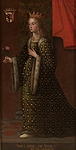
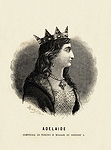
Adelaide
di Torino
Contessa di Torino
(c. 1020–91)
Other names: Adelaide of Susa
the mighty Marchioness
Biographical
Contessa di Torino
>1034–60
Signora di Torino >1034–60
Signora di Auriate
>1034–60
Signora di Bredulo
>1034–60
Signora di Brusaporcello >1034–60
Signora di Asti
>1034–60
Signora di Alba
>1034–60
Signora di Albenga
>1034–60
Signora di Ventimiglia
>1034–60
Signora di San Dalmazzo
?-1060
Signora di Boves >1034–60
Regent of Savoy 1060–64, 1080
Adelaide of Turin, is regarded as one of the founders of the house of
Savoy. That family was already extending its borders on the ruins of the
kingdom of Burgundy, but its first footing in Italy was given to it by
the marriage with Adelaide, elder daughter and heir of Manfred, marquis
of Turin,
(†1034)
whose rule extended from the top of the Alps to the Dora Baltea and the
Po. Adelaide married three times, and the mark of Turin could not be held
by a woman, but she could transfer her claim to her husband. Accordingly,
her first husband, Herman of Swabia, obtained the investiture of the marquisate
from his stepfather, the Emperor, Conrad II. Herman died, in 1038, and
Adelaide took upon herself the government of her father's inheritance.
She soon married again, and it was not long before she was again a widow.
She then married Odo of Savoy, son of Humbert, one of the most powerful
princes of the kingdom of Burgundy. Odo eventually succeeded to Savoy,
but little is known about him. Adelaide is the more prominent person;
with masculine courage and energy, she knew right well how to rule. It
was of immense importance to the family destined to become so great that
Adelaide could hold the command of the Burgundian as well as the Italian
possessions of the house. Far and wide the 'marchioness of Susa' was known
as a woman of no less decision than prudence.
While Adelaide was the real ruler and the legal possessor of the Ardoinid
demesnes, the formal aspect of things was somewhat different. By January
1064 her eldest son, Peter I, was invested with the mark of Turin and
he remained possessed of the 'public powers' until his death. Adelaide
held the comital office under him. She continued to hold on to real power
over the mark under the rule of her son, Amadeus II, and then under Frédéric
de Montbéliard, marquis of Turin by virtue of his wife, Agnès,
Peter's daughter and heiress of the mark.
Adelaide maintained order and justice in her territories. She was grasping
and hard, rather feared and respected than beloved. Her neighbours had
to be on the alert, and she more than once took up arms against her own
towns. She waged a long war with the citizens of Asti, and in 1070 she
took the town and destroyed it. The year before that she had besieged
Lodi and reduced it almost to a heap of rubbish. Thousands of persons
were killed; cloisters and churches were not spared. She inflicted so
much misery that when she asked the Pope for absolution he had difficulty
in devising a sufficient penance for her. She was in touch with all the
conflicting movements of that restless time, yet was carried away by none
of them, and although upright and conscientious, she kept her eye constantly
on the interests of her own family and country. She was an enthusiastic
partisan of the German Imperial side against the Papal party; but still
she was religious, and favoured the ecclesiastical reforms then emanating
from Rome, including steps and protests against simony and the marriage
of the clergy. Such was the woman whose alliance was sought by the Emperor
Henry III the Black, in order to balance the power of two other masculine
and masterful women, the marchioness Beatrice of Tuscany, and her daughter
the countess Matilda, whose influence was often in the opposite scale
to his interest. In 1055 he betrothed his son Henry at five years old
to Bertha, the eldest daughter of Adelaide, and in less than a year the
Emperor was dead. Henry IV and Bertha married in 1066. Later, a struggle
between Henry IV and Pope Gregory VII emerged, and Adelaide undertook
to assist her son-in-law, and but for her aid he would probably have lost
his crown and his liberty. At the same time, she exacted from his necessity
some increase to her own dominions, for she bargained for the cession
of five rich bishoprics as the reward of her assistance. It is believed
that she then obtained the right to certain territories and privileges
in the marquisate of Ivrea, to which she had a claim through her mother,
but which she could not grasp without the imperial sanction. Adelaide
and her son, Amadeus, came to meet the fugitive Emperor, his wife and
infant son Conrad, and braved with them the hardships and difficulties
of the passage across the Alps in January 1077. It was one of the coldest
winters ever known, and the snow lay deep in Rome for weeks, and the usual
routes were almost impassable. At last they arrived at a hospitable monastery
in the Val d'Aosta. They were well received in Italy, where there seemed
more favour for the king, and less for the Pope, than in Germany; but
even now all would be lost if Henry did not receive the Holy Father's
absolution, so he hurried on, accompanied by Adelaide, to Canossa, where
Gregory was resting in the impregnable castle of his devoted partisan,
the countess Matilda. These two famous women had so much power in the
affairs of Italy that the king's fate was, to a considerable degree, in
their hands. Matilda, though devoted to Gregory, pitied the humiliations
and sufferings to which the Emperor was subjected, and it was she who
at length prevailed on her guest to put an end to the cruel delays and
abasement of his unfortunate penitent, so that after days of miserable
entreaty, during which he shivered outside the gate in the garb of the
humblest penitent, on the 28th of January 1077, Gregory gave him absolution,
but made his own hard terms, to which Henry was obliged to agree. Adelaide
lived fourteen years after the melancholy expedition to Canossa. She was
still alive when, in 1084, Henry led an avenging army to Rome, and compelled
Gregory to take flight to Salerno. In her old age her conscience was troubled,
not apparently by the slaughter of her rebellious subjects, but because
she had had three husbands. She tried to atone for her sins by works of
beneficence, and gave bountifully to religious institutions. Fructuaria
and other monasteries thrived under her patronage. She died in 1091, having
bequeathed the marquisate of Italy to her son, Peter.
Some modern historians have doubted the three
marriages of Adelaide, with some believing in the contemporary existence
of two Adelaides: one marrying Hermann of Swabia and to Enrico
di Monferrato, and the other marrying
Odo of Savoy, although there is documentary evidence to support all three
of her marriages that would have taken place during her youth.
Place of death: Canischio in Canavese
Place of burial: Cathedral of San Giovanni, Turin
Daughter of Manfredo Udalrico of Turin (Arduino) and Berta degli Obertenghi
(Este). She was married firstly to Hermann IV of Swabia (Babenberg) in
1035 (possibly, with issue), secondly to Enrico di Monferrato (Aleram)
in 1042 (no issue), and thirdly to OddonI de Savoie in 1046 (with issue).
Sources
1. Società Genealogica Italiana. Enciclopedia Genealogica del Mediterraneo. 2005–2018.
2. Agnes B.C. Dunbar. A Dictionary of Saintly Women, vol. 1. London: George Bell & Sons, 1904.
3. C. Cawley. Medieval Lands - A prosopography of medieval European noble and royal families. The Foundation for Medieval Genealogy, ©2018.
4. C.W. Previté-Orton. The Early History of the House of Savoy. Cambridge: University Press, 1912.
5. Enciclopedia italiana di scienze, lettere ed arti, vol. 7 Bil - Bub. Milano: Ist. Giovanni Treccani, 1930.
Families | Lands | Abbreviations and Symbols
© 2024 The Universal Compendium